Pular para o conteúdo
Atlas Anatolia
NotíciasIce Age teeth in Sulawesi push betel-nut use back as far as 25,000 yearsRoman mosaic and Eros head uncovered in the basilica at Pompeiopolis, Kastamonu
Knossos — Greece

Wikimedia Commons (CC BY-SA)

Continent Record

Southernmost Known Site in Europe

ComplexoDestaque

Knossos

Seyfi Cem Baskin

Κνωσός1900 a.C. – 1100 a.C.

Largest Bronze Age palace on Crete, centre of Minoan court life, fresco painting, and labyrinth myth. Arthur Evans's reconstructions remain controversial, yet the core of the West Court, Grand Staircase, and storage magazines reveals a complex that shaped how we picture Aegean prehistory.

422
Interesse 78

Localização

Crete · Heraklion · Grécia

35.30°N · 25.16°E · Europa

Built

First palace built c. 1900 BCE; second palace c. 1700 BCE

Civilization

Minoan

Discovered

Excavated by Arthur Evans from 1900 CE

Status

UNESCO World Heritage tentative list (Minoan Palatial Centres)

Writing

Linear A (undeciphered) and Linear B (early Greek) tablets found

Area

Palace covers approximately 20,000 square meters

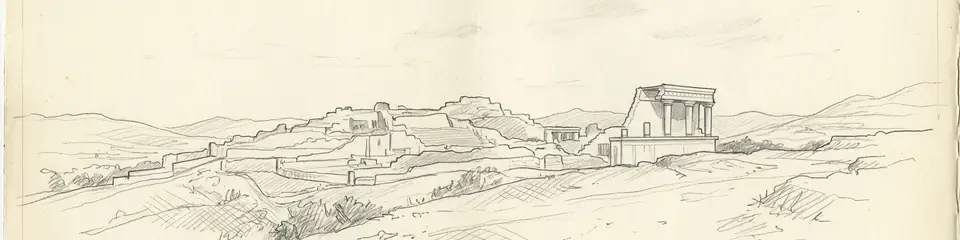
Graphite pencil sketch banner of Knossos

“Knossos defined "Minoan" civilisation in public imagination and holds the throne room that still anchors Aegean myth.”

Localização

Visão geral

Knossos lies south of Heraklion in north-central Crete, where the Kairatos stream meets a gentle slope. Middle and Late Bronze Age builders turned the site into the largest palace complex in the Aegean: hundreds of rooms, pier-and-door partitions, light wells, frescoed walls, and vast storage magazines that held olive oil and wine in giant pithoi jars.

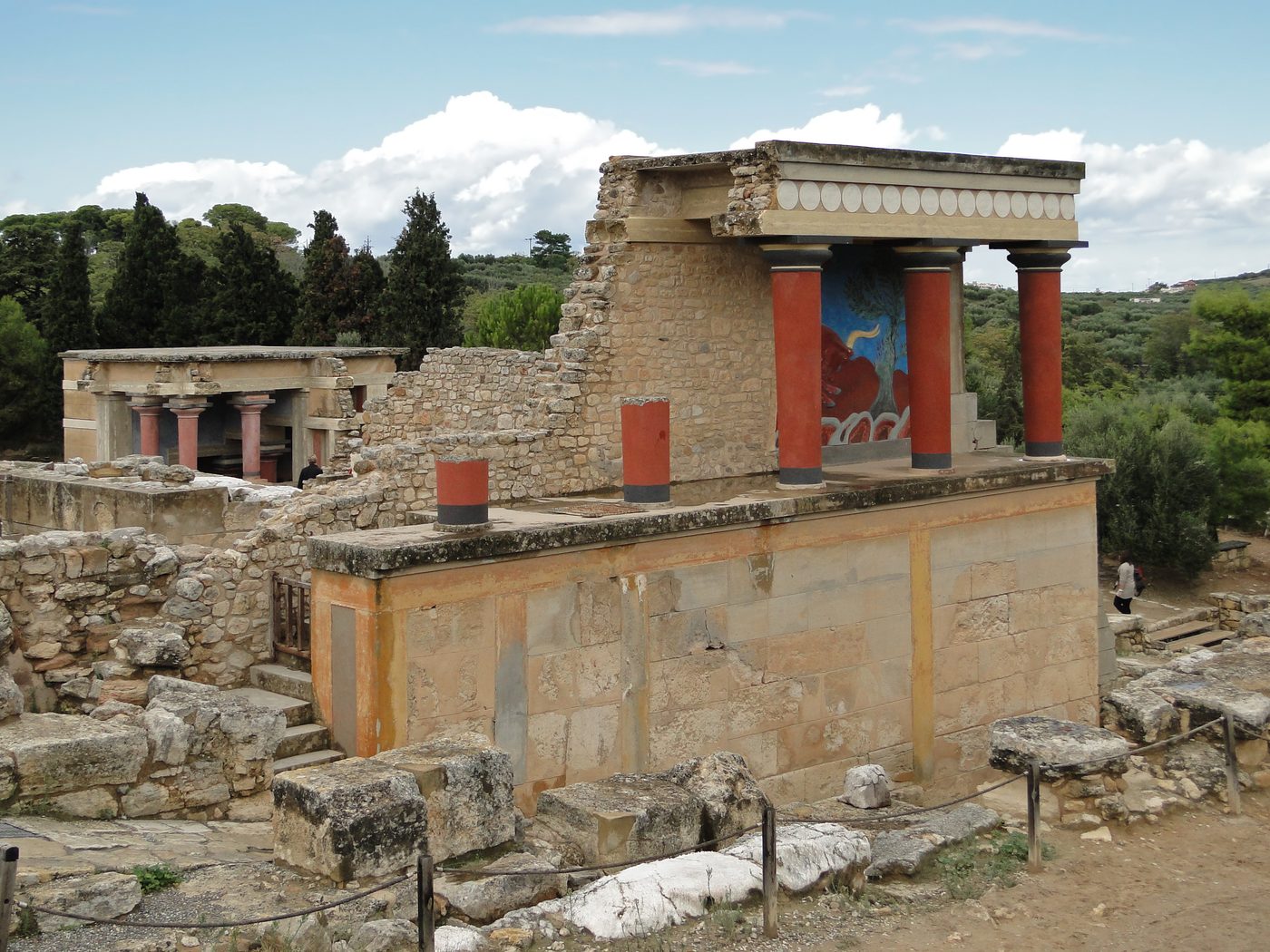
Sir Arthur Evans purchased the site in 1900 and excavated for decades, popularising the term "Minoan" and reconstructing parts of the palace in concrete and paint. Specialists still argue over how much of what visitors see is ancient fabric versus Evans's imagination. Underneath the debate lies genuine architecture: the Throne Room with its gypsum seat and griffin fresco, the Grand Staircase, the Royal Road, and the drain systems that kept the low levels dry.
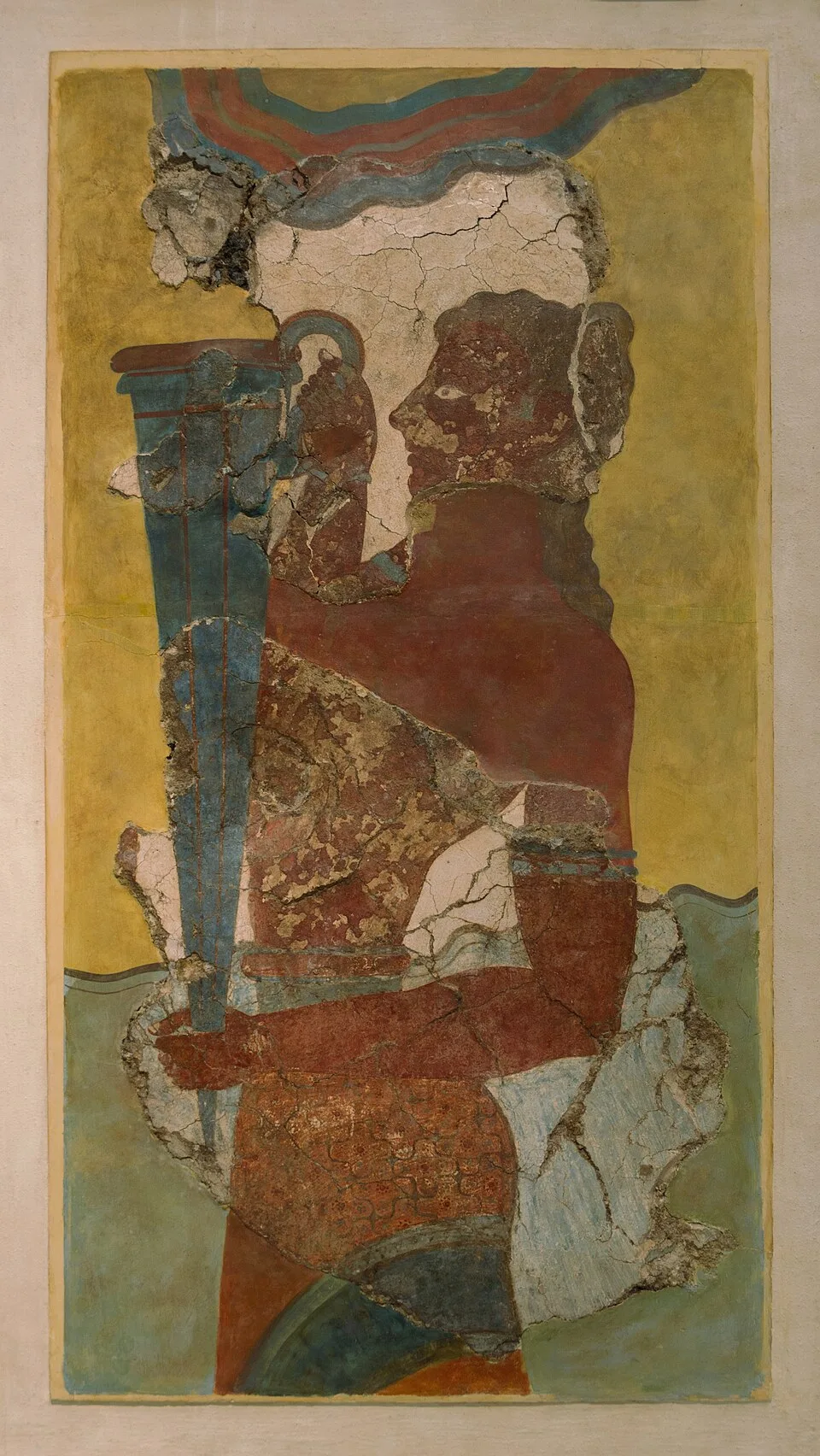
The "cup bearer" fresco Knossos Heraklion museum Crete Greece
The "cup bearer" fresco Knossos Heraklion museum Crete Greece | Jebulon (CC0)
"There is a land called Crete, in the midst of the wine-dark sea, a fair land and a rich, begirt with water, and therein are many men, past counting, and ninety cities. And among the cities is the great city Knossos, where Minos was king for nine years."
— Homer, Odyssey XIX.172–179, c. 8th century BCE

Linear A and Linear B tablets appear in the palace archive; Linear B was deciphered as Greek, but the earlier Linear A language remains unknown. Minoan Crete traded with Egypt, the Levant, and the Greek mainland. Frescoes show bull-leaping, processions, and marine life. The myth of the Minotaur and the labyrinth likely crystallised memory of this palace's confusing plan.
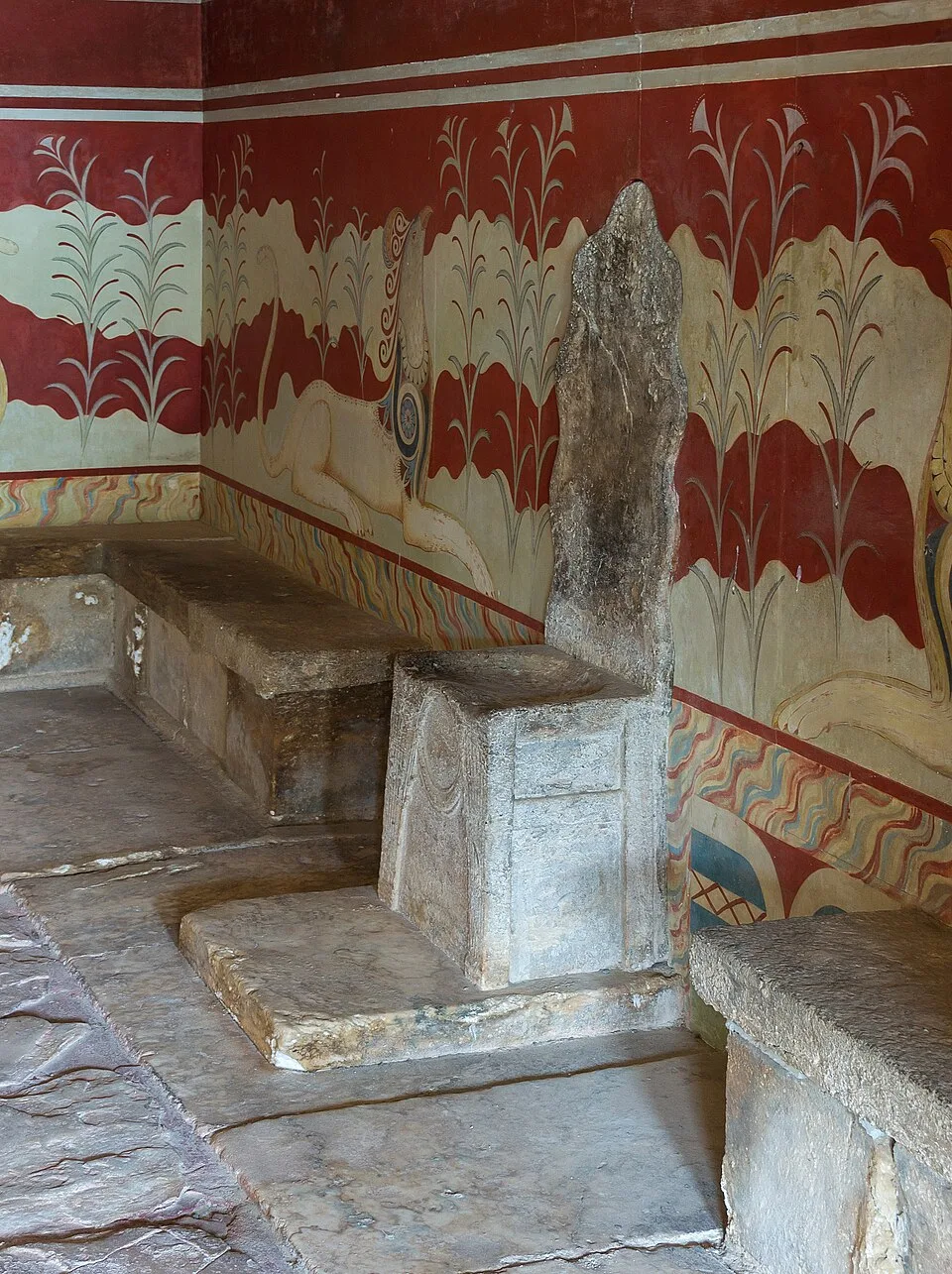
Throne of Minos at Knossos Palace
Throne of Minos at Knossos Palace | Jebulon (CC0)

Homer's Odyssey sends Odysseus and his crew to Crete in stories within stories; the island's prestige echoes Minoan greatness even after the palaces burned around 1450 BCE. Compare Knossos with Akrotiri on Thera, a town preserved by volcanic ash without palatial reconstruction.

Knossos appears on screen when directors want Aegean colour and mythic scale. The archaeology itself is enough: stand in the Throne Room and you understand why later Greeks imagined a king of bulls here.
Por que isso importa

Knossos defined "Minoan" civilisation in public imagination and holds the throne room that still anchors Aegean myth. Its archives bridged undeciphered Linear A and readable Linear B, a Rosetta moment for Bronze Age languages.

Evidências e interpretação

Distinguir o que está bem estabelecido do que permanece em debate.

Fatos bem estabelecidos

4
  • The palace was destroyed and rebuilt multiple times, with evidence of fire and earthquake damage across different strata.
  • Linear B tablets from Knossos provide the earliest written records of the Greek language, dating to the Late Bronze Age.
  • Frescoes such as the 'Bull-Leaping Fresco' depict ritual activities likely associated with Minoan religion.
  • The earliest Neolithic settlement at Knossos dates to c. 7000 BCE, making it one of the oldest continually inhabited places in Europe.

Inferências acadêmicas

2
  • The Throne Room, with its stone seat and griffin frescoes, likely served a ceremonial or religious function, possibly for a priest-king.
  • Massive storage magazines and an advanced drainage system indicate a redistributive economy managed by a central authority.

Interpretações debatidas

2
  • Whether Knossos was a royal residence, a temple, or a combination of both remains a matter of scholarly dispute.
  • The existence of a Minoan king—and, if so, the nature of monarchic power—is contested; some scholars argue for collective governance.

Descoberta e escavação

Post-Evans investigations

Dirigido por British School at Athens, various scholars

Subsequent work by the British School at Athens, including stratigraphic excavations and studies of the Linear B archive, refined the site's chronology and context.

Modern conservation

Dirigido por Hellenic Ministry of Culture and Sports

Since the 1950s, the Greek Ministry of Culture has conducted conservation and restoration to stabilize structures and manage tourism impact.

1900–1905

Initial excavations by Arthur Evans

Dirigido por Sir Arthur Evans

Major uncovering of the palace complex, revealing the Central Court, Throne Room, and storage areas. Evans published 'The Palace of Minos at Knossos' in four volumes.

1922–1930

Later Evans campaigns

Dirigido por Arthur Evans and the British School at Athens

Evans continued excavations and restoration, reconstructing parts of the palace with concrete, a practice now criticized for being speculative.

Fotos da comunidade

Compartilhe sua experiência

Você visitou este sítio? Envie suas fotos para ajudar outros a descobri-lo.

Histórias relacionadas

Como citar esta página

Atlas Anatolia. (1900). Knossos. Atlas Anatolia. https://atlasanatolia.com/pt/site/knossos

Conteúdo licenciado sob CC BY-SA 4.0 — atribuição necessária ao reutilizar.

Gráfico

Conexões com sítios e histórias relacionados.

Fontes

  • MacGillivray, J.A. (2000). Minotaur: Sir Arthur Evans and the Archaeology of the Minoan Myth. — J.A. MacGillivray (2000)
  • Driessen, J. (1990). An Early Destruction in the Mycenaean Palace at Knossos. Peeters. — Jan Driessen (1990)
  • UNESCO World Heritage tentative list: Minoan Palatial CentresLink
  • Bennet, J. (1985). 'The Structure of the Linear B Administration at Knossos.' American Journal of Archaeology 89: 231-249. — John Bennet (1985)
  • Hitchcock, L.A. and Preziosi, D. (1999). Aegean Art and Architecture. Oxford University Press. — Louise A. Hitchcock and Donald Preziosi (1999)
  • Warren, P.M. and Hankey, V. (1989). Aegean Bronze Age Chronology. Bristol Classical Press. — Peter M. Warren and Vronwy Hankey (1989)

Perguntas frequentes

Onde fica Knossos?

Knossos está localizado em Crete, Heraklion, Greece.

Qual é a antiguidade de Knossos?

Knossos data de aproximadamente 1900 a.C. – 1100 a.C..

Quais civilizações estão associadas a Knossos?

Knossos está associado à civilização Minoan.

Por que Knossos é importante?

Knossos defined "Minoan" civilisation in public imagination and holds the throne room that still anchors Aegean myth.

Knossos é um Patrimônio Mundial da UNESCO?

Knossos não está atualmente inscrito na Lista do Patrimônio Mundial da UNESCO.