
Pular para o conteúdo
Atlas Anatolia
NotíciasIce Age teeth in Sulawesi push betel-nut use back as far as 25,000 yearsRoman mosaic and Eros head uncovered in the basilica at Pompeiopolis, Kastamonu
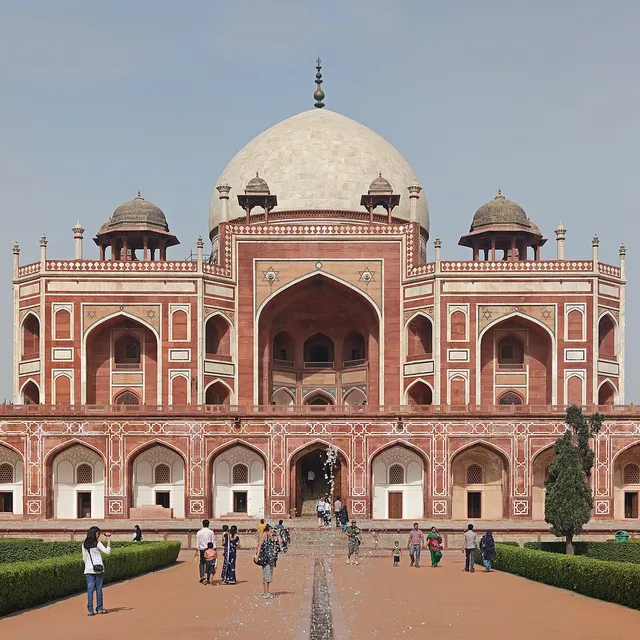
Humayun's Tomb and charbagh garden, Delhi

Wikimedia Commons

Country Record

Oldest Monument in India

PatrimônioMonumentoUNESCODestaque

Humayun's Tomb

Seyfi Cem Baskin

हुमायूँ का मकबरा1565 d.C. – 1572 d.C.

The red-sandstone and white-marble garden tomb built in Delhi for the Mughal emperor Humayun (d. 1556) — a charbagh mausoleum whose double dome and symmetrical layout directly inspired the Taj Mahal and ranks among the most visited monuments in India.

21
Interesse 71

Localização

Índia

28.59°N · 77.25°E · Ásia

Built

c. 1565–1572 CE for Emperor Humayun

Patron

Bega Begum (Haji Begum), Humayun's widow

Layout

Charbagh garden tomb with double dome

UNESCO

World Heritage Site (1993)

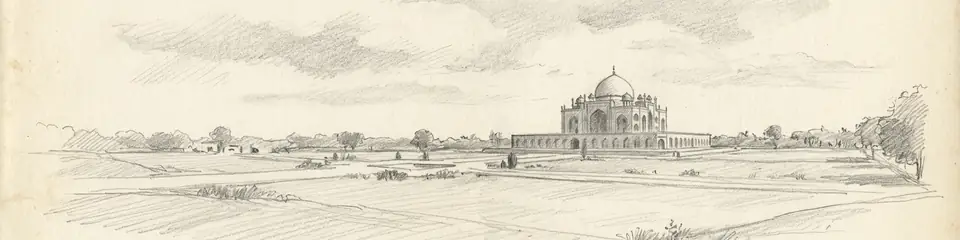
Graphite pencil sketch banner of Humayun's Tomb

“Humayun's Tomb is the structural prototype of the Taj Mahal — the first fully realised Mughal garden tomb on the Yamuna-Ganges plain.”

Localização

Visão geral

Humayun's Tomb stands in the Nizamuddin district of Delhi on a platform within a charbagh garden divided by water channels. The empress Bega Begum (Haji Begum) commissioned the mausoleum after Humayun's death in 1556; construction began about 1565 and was substantially complete by 1572. Mirak Mirza Ghiyas, a Persian architect, is traditionally credited with the design.

The building combines Timurid tomb typology — a high double dome, pishtaq entrance arches, chhatri kiosks — with Indian red sandstone and white marble inlay. The central chamber holds Humayun's cenotaph; over 150 Mughal family members were later buried in the complex, making it a dynastic necropolis. After the 1857 rebellion and British occupation, the gardens deteriorated until a major Aga Khan Trust restoration in the early 21st century.

UNESCO inscribed Humayun's Tomb in 1993 as an early masterpiece of Mughal architecture that prefigured the Taj Mahal. It anchors Delhi's "Mughal triangle" with the Red Fort and Qutb Minar on heritage itineraries.

Por que isso importa

Humayun's Tomb is the structural prototype of the Taj Mahal — the first fully realised Mughal garden tomb on the Yamuna-Ganges plain. Its restoration became a model for public–private heritage conservation in India and revived the charbagh landscape as integral to the monument.

Evidências e interpretação

Distinguir o que está bem estabelecido do que permanece em debate.

Fatos bem estabelecidos

2
  • Mughal chronicles and inscriptions name Humayun, Bega Begum, and the completion date in the 1570s.
  • Architectural comparison confirms Timurid tomb forms adapted to Delhi red sandstone–marble workshops.

Inferências acadêmicas

1
  • The tomb's design directly influenced Shah Jahan's Taj Mahal programme — inferred from formal precedent and court workshop continuity.

Fotos da comunidade

Compartilhe sua experiência

Você visitou este sítio? Envie suas fotos para ajudar outros a descobri-lo.

Como citar esta página

Atlas Anatolia. (1565). Humayun's Tomb. Atlas Anatolia. https://atlasanatolia.com/pt/site/humayuns-tomb

Conteúdo licenciado sob CC BY-SA 4.0 — atribuição necessária ao reutilizar.

Fontes

  • Mughal Architecture — Koch, Ebba (1991)
  • UNESCO — Humayun's TombLink

Perguntas frequentes

Onde fica Humayun's Tomb?

Humayun's Tomb está localizado em India.

Qual é a antiguidade de Humayun's Tomb?

Humayun's Tomb data de aproximadamente 1565 d.C. – 1572 d.C..

Quais civilizações estão associadas a Humayun's Tomb?

Humayun's Tomb está associado à civilização Mughal.

Por que Humayun's Tomb é importante?

Humayun's Tomb is the structural prototype of the Taj Mahal — the first fully realised Mughal garden tomb on the Yamuna-Ganges plain.

Humayun's Tomb é um Patrimônio Mundial da UNESCO?

Sim — Humayun's Tomb está inscrito na Lista do Patrimônio Mundial da UNESCO.