
Pular para o conteúdo
Atlas Anatolia
NotíciasIce Age teeth in Sulawesi push betel-nut use back as far as 25,000 yearsRoman mosaic and Eros head uncovered in the basilica at Pompeiopolis, Kastamonu
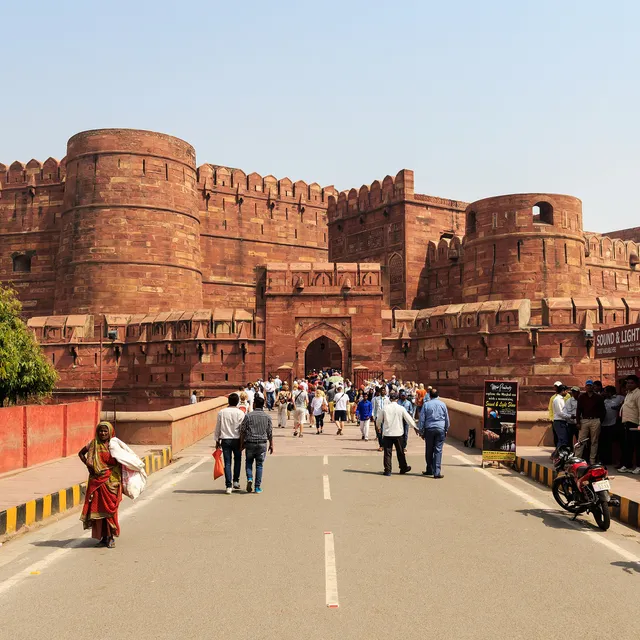
Red sandstone walls and gates of Agra Fort, India

Wikimedia Commons

Country Record

Oldest Fortress in India

PatrimônioFortalezaUNESCODestaque

Agra Fort

Seyfi Cem Baskin

आगरा किला1565 d.C. – 1857 d.C.

The massive red-sandstone fortress on the Yamuna at Agra — seat of Akbar, Jahangir, and Shah Jahan before the Mughal court moved to Delhi — whose palaces and mosques face the Taj Mahal across the river and draw millions of visitors on India's Golden Triangle circuit.

21
Interesse 75

Localização

Índia

27.18°N · 78.02°E · Ásia

Built

Major phase c. 1565–1573 CE under Akbar; later marble works by Shah Jahan

Material

Red sandstone with white marble imperial apartments

View

Musamman Burj overlooks the Taj Mahal across the Yamuna

UNESCO

World Heritage Site (1983)

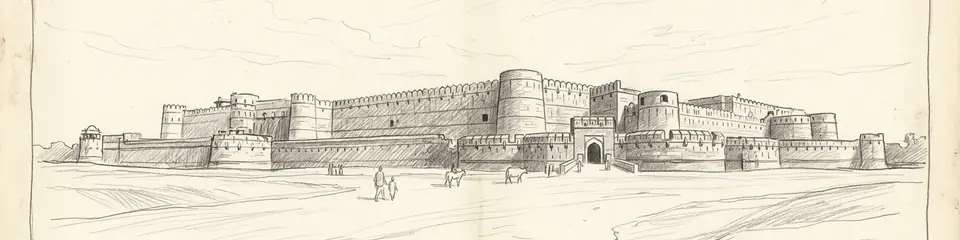
Graphite pencil sketch banner of Agra Fort

“Agra Fort is the military and residential counterpart to the Taj Mahal — together they document Mughal power, aesthetics, and riverine urban planning at its peak.”

Localização

Visão geral

Agra Fort (Lal Qila) rises on the right bank of the Yamuna River in Agra, Uttar Pradesh, forming a crescent-shaped walled complex roughly 2.5 kilometres in circumference. Akbar the Great ordered its reconstruction in red sandstone beginning about 1565 on the site of an earlier fort; successive emperors added marble palaces, audience halls, and gardens. Shah Jahan's white-marble Musamman Burj tower — where he was imprisoned by Aurangzeb — offers the famous view toward the Taj Mahal.

The fort combines military architecture (double ramparts, moat, angled bastions) with refined residential courts: the Jahangir Mahal, Khas Mahal, Diwan-i-Am, and Diwan-i-Khas. Pietra dura, carved brackets, and inlaid marble reflect the same workshops that later built the Taj. After the Mughal decline the fort passed through Maratha and British control; much of the interior was adapted for barracks and administration.

The Archaeological Survey of India now manages the monument. UNESCO listed Agra Fort in 1983 alongside the Taj Mahal as a defining Mughal ensemble of the Yamuna corridor.

Por que isso importa

Agra Fort is the military and residential counterpart to the Taj Mahal — together they document Mughal power, aesthetics, and riverine urban planning at its peak. Its continuous occupation from the 16th century preserves one of the largest and best-studied Islamic fort-palaces in South Asia.

Evidências e interpretação

Distinguir o que está bem estabelecido do que permanece em debate.

Fatos bem estabelecidos

2
  • Mughal court chronicles and inscriptions attribute the Akbar-period rebuilding and Shah Jahan marble additions to documented imperial workshops.
  • Architectural analysis confirms Timurid–Mughal vaulting, jali screens, and pietra dura consistent with 16th–17th-century imperial ateliers.

Inferências acadêmicas

1
  • The fort's riverfront orientation was intended to integrate Yamuna transport and garden-tomb axes linking Agra's palatial and funerary landscapes.

Fotos da comunidade

Compartilhe sua experiência

Você visitou este sítio? Envie suas fotos para ajudar outros a descobri-lo.

Como citar esta página

Atlas Anatolia. (1565). Agra Fort. Atlas Anatolia. https://atlasanatolia.com/pt/site/agra-fort

Conteúdo licenciado sob CC BY-SA 4.0 — atribuição necessária ao reutilizar.

Fontes

  • Mughal Architecture — Koch, Ebba (1991)
  • UNESCO — Agra FortLink

Perguntas frequentes

Onde fica Agra Fort?

Agra Fort está localizado em India.

Qual é a antiguidade de Agra Fort?

Agra Fort data de aproximadamente 1565 d.C. – 1857 d.C..

Quais civilizações estão associadas a Agra Fort?

Agra Fort está associado à civilização Mughal.

Por que Agra Fort é importante?

Agra Fort is the military and residential counterpart to the Taj Mahal — together they document Mughal power, aesthetics, and riverine urban planning at its peak.

Agra Fort é um Patrimônio Mundial da UNESCO?

Sim — Agra Fort está inscrito na Lista do Patrimônio Mundial da UNESCO.