
Pular para o conteúdo
Atlas Anatolia
NotíciasIce Age teeth in Sulawesi push betel-nut use back as far as 25,000 yearsRoman mosaic and Eros head uncovered in the basilica at Pompeiopolis, Kastamonu
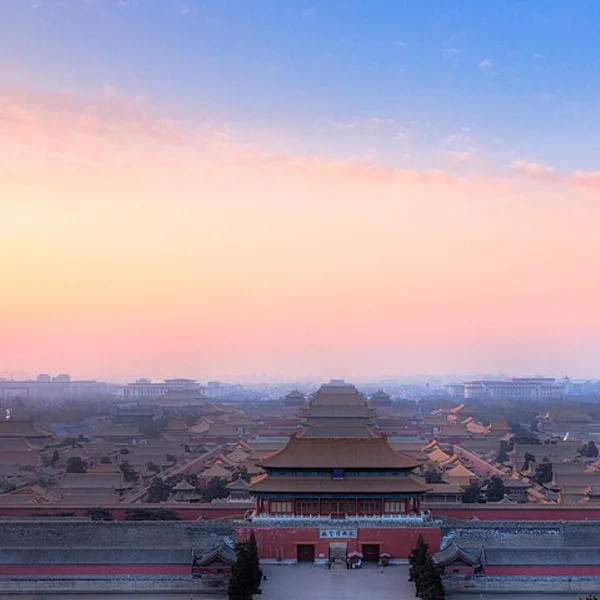
The Forbidden City palace roofs seen from Jingshan Coal Hill, Beijing

Wikimedia Commons

PatrimônioComplexoUNESCODestaque

Forbidden City

Seyfi Cem Baskin

紫禁城1406 d.C. – 1912 d.C.

The vast Ming–Qing imperial palace at the heart of Beijing — nearly a thousand buildings within vermilion walls — whose courts and gates staged five centuries of Chinese emperors and remains among the most visited historic sites in the world.

21
Interesse 90

Localização

China

39.92°N · 116.40°E · Ásia

Built

1406–1420 CE under the Yongle Emperor (Ming)

Area

~72 ha within walls; ~980 buildings

Museum

Palace Museum (Gugong) since 1925

UNESCO

Imperial Palaces of Ming and Qing (1987)

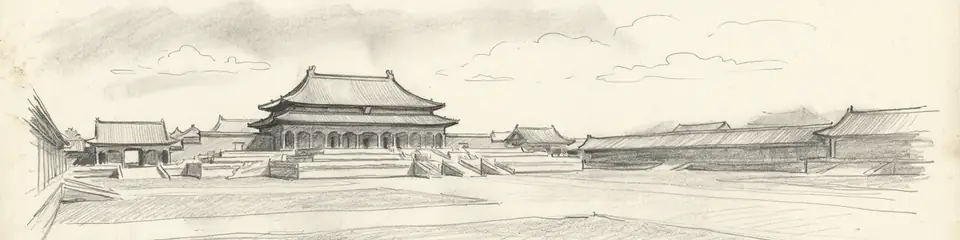
Graphite pencil sketch banner of Forbidden City

“The Forbidden City is the best-preserved imperial palace complex in East Asia and the physical expression of Chinese cosmological statecraft — axial order, colour codes, and gate hierarchies that structured imperial power for half a millennium.”

Localização

Visão geral

The Forbidden City (Zijin Cheng, "Purple Forbidden City") occupies the central north–south axis of historic Beijing. The Yongle Emperor (Zhu Di) of the Ming dynasty began its construction in 1406, moving the primary capital from Nanjing; the complex was largely complete by 1420. For almost five centuries it housed the Ming and Qing imperial households, their bureaucracies, and ritual life, until the abdication of the last Qing emperor Puyi in 1912. Ordinary subjects were barred from entering — hence "forbidden" — while officials and envoys passed through a graded sequence of gates and courtyards toward the throne halls.

The palace covers roughly 72 hectares within a rectangular wall and moat, containing on the order of 980 surviving buildings and some 8,700 rooms (traditional counts vary). Architecture follows strict axial symmetry: the Outer Court (Taihe, Zhonghe, Baohe halls) hosted state ceremonies; the Inner Court housed the emperor's residence and the empress's quarters, with the Imperial Garden at the north end. Timber post-and-beam halls rest on white marble terraces; roofs are glazed yellow tile (imperial colour), with bracket sets (dougong) distributing weight. Qing rulers added Manchu ritual elements while preserving Ming spatial order.
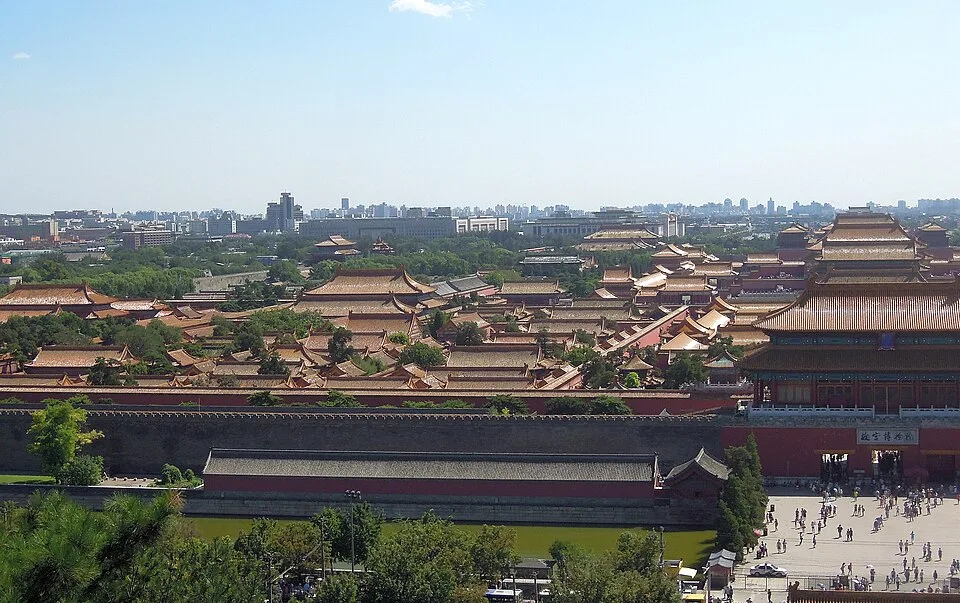
China (Beijing) Aerial view of Forbidden City (38884882275)
China (Beijing) Aerial view of Forbidden City (38884882275) | Güldem Üstün from Istanbul, TURKEY (CC BY 2.0)
"The Son of Heaven dwells in the centre of the earth; his palace faces south, the direction of virtue, and the five gates open upon the five directions of the realm."
— Paraphrase of Ming ritual cosmology applied to Beijing's axial palace layout
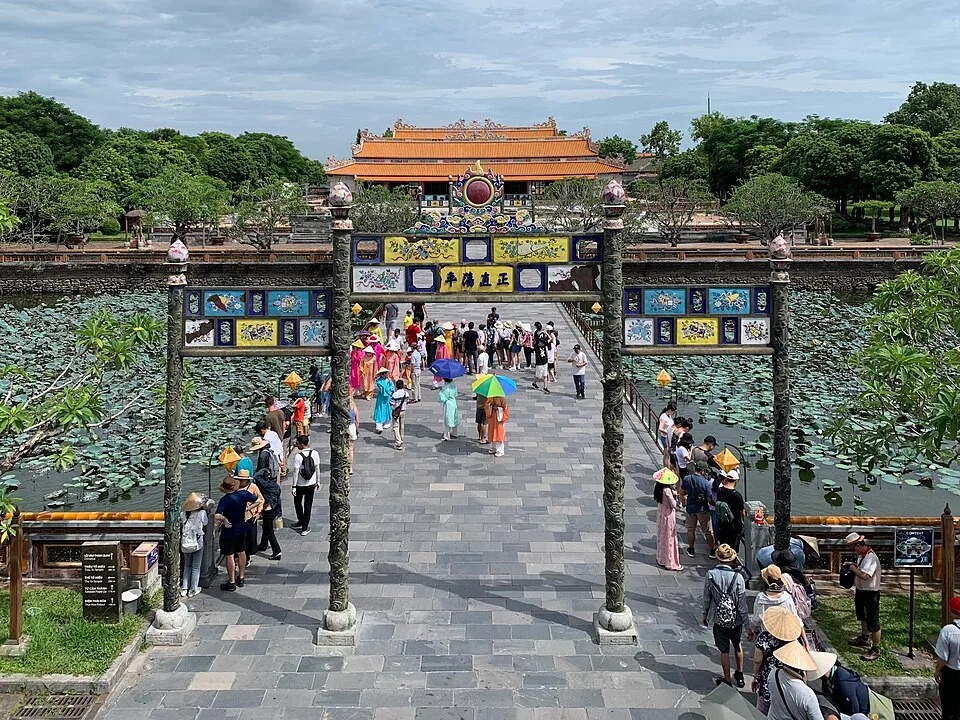
Huế 2024 - Meridian Gate - Ngọ Môn Hoàng thành Huế - img 07
Huế 2024 - Meridian Gate - Ngọ Môn Hoàng thành Huế - img 07 | Chainwit. (CC BY 4.0)
"Nine thousand rooms under yellow tiles — a city within the city, closed to the common wind."
— Paraphrase of Qing palace descriptions of the Forbidden City
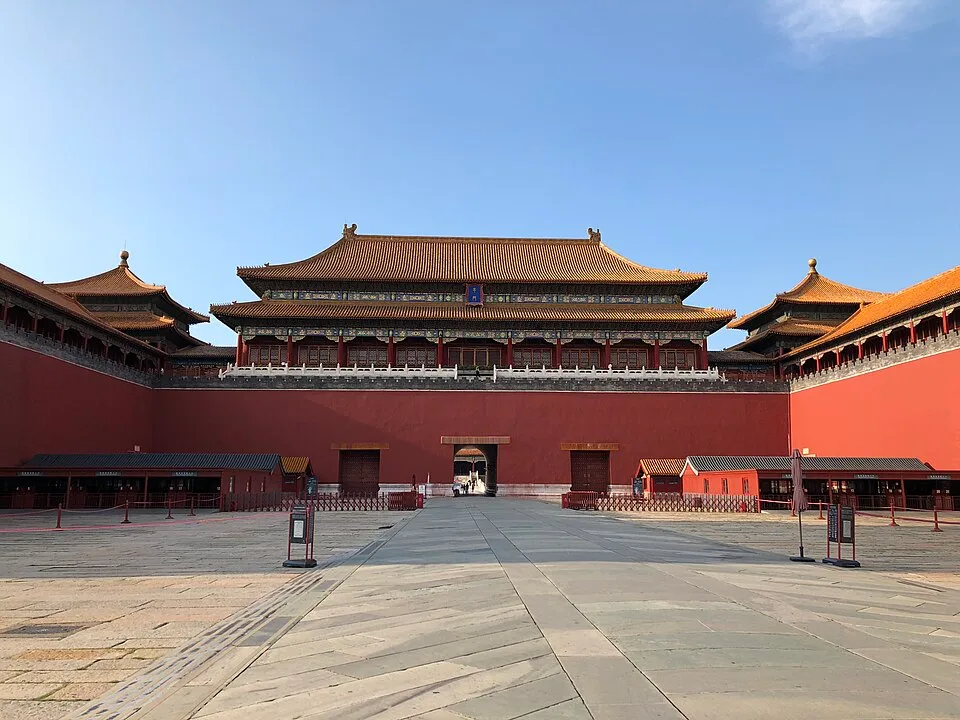
Meridian Gate Forbidden City 2018-08-18 170110
Meridian Gate Forbidden City 2018-08-18 170110 | David290 (CC BY-SA 4.0)

After 1925 the complex opened as the Palace Museum (Gugong), one of the world's largest collections of Chinese art — bronzes, ceramics, painting, jade, and court regalia evacuated to Taiwan during the civil war form a parallel collection at the National Palace Museum, Taipei. UNESCO listed the Imperial Palaces of the Ming and Qing in Beijing and Shenyang in 1987. Visitor numbers rank among the highest of any historic monument globally.
Por que isso importa

The Forbidden City is the best-preserved imperial palace complex in East Asia and the physical expression of Chinese cosmological statecraft — axial order, colour codes, and gate hierarchies that structured imperial power for half a millennium. Its conversion into the Palace Museum made it the public face of Chinese art history, while its architecture remains the reference point for understanding Ming–Qing court ritual and urban planning.

Evidências e interpretação

Distinguir o que está bem estabelecido do que permanece em debate.

Fatos bem estabelecidos

2
  • Ming and Qing archival records, gate plaques, and ritual manuals document construction phases, court ceremonies, and spatial regulations.
  • Architectural survey confirms axial planning, dougong bracket systems, and marble terrace platforms consistent with 15th–18th-century imperial workshops.

Inferências acadêmicas

1
  • Yongle's relocation of the capital from Nanjing to Beijing was intended to secure the northern frontier and reclaim Mongol-era prestige — inferred from contemporary policy and ritual emphasis.

Fotos da comunidade

Compartilhe sua experiência

Você visitou este sítio? Envie suas fotos para ajudar outros a descobri-lo.

Histórias relacionadas

Como citar esta página

Atlas Anatolia. (1406). Forbidden City. Atlas Anatolia. https://atlasanatolia.com/pt/site/forbidden-city

Conteúdo licenciado sob CC BY-SA 4.0 — atribuição necessária ao reutilizar.

Gráfico

Conexões com sítios e histórias relacionados.

Fontes

  • The Forbidden City — Roderick Whitfield (2006)
  • UNESCO — Imperial Palaces of the Ming and Qing Dynasties in Beijing and ShenyangLink

Perguntas frequentes

Onde fica Forbidden City?

Forbidden City está localizado em China.

Qual é a antiguidade de Forbidden City?

Forbidden City data de aproximadamente 1406 d.C. – 1912 d.C..

Quais civilizações estão associadas a Forbidden City?

Forbidden City está associado à civilização Ming.

Por que Forbidden City é importante?

The Forbidden City is the best-preserved imperial palace complex in East Asia and the physical expression of Chinese cosmological statecraft — axial order, colour codes, and gate hierarchies that structured imperial power for half a millennium.

Forbidden City é um Patrimônio Mundial da UNESCO?

Sim — Forbidden City está inscrito na Lista do Patrimônio Mundial da UNESCO.