
콘텐츠로 건너뛰기
Atlas Anatolia
디그
뉴스술라웨시 빙하기 치아에서 빈랑 사용 25,000년 전까지 소급카스타모누 폼페이오폴리스 바실리카에서 로마 모자이크와 에로스 두상 발견
Aerial view of the Winter Palace green facade on the Neva River, St Petersburg

Wikimedia Commons (CC BY)

유산복합 단지유네스코주요

Winter Palace

Seyfi Cem Baskin

Зимний дворец1754 서기 – 1917 서기

The green-and-white Baroque palace on Palace Embankment in St Petersburg — seat of the Romanov tsars from 1762 and core of the State Hermitage Museum — ranks second among missing sites in our multilingual pageview audit and defines Russian imperial spectacle.

21
관심 76

위치

러시아

59.94°N · 30.31°E · 유럽

Built

1754–1762 under Empress Elizabeth (Rastrelli)

Hermitage

Catherine II began collection 1764; museum from 1852

1917

Stormed 25 October — Bolshevik revolution icon

UNESCO

Historic Centre of Saint Petersburg (1990)

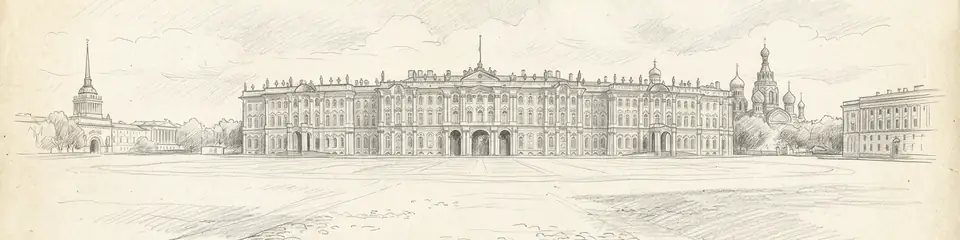
Graphite pencil sketch banner of Winter Palace

“The Winter Palace is where Romanov court ritual met global art collecting — architecture, monarchy, and museum in one Neva frontage.”

위치

개요

The Winter Palace stands on the Neva River embankment in central St Petersburg, Russia. Peter the Great founded the city in 1703; after intermediate palaces, Empress Elizabeth commissioned Bartolomeo Rastrelli's Baroque masterpiece (1754–1762), a facade nearly a kilometre long with hundreds of rooms, gilded state apartments, and the Jordan Staircase where courtiers greeted the tsar on feast days.

Catherine the Great added the Small Hermitage (1764) to house her art collection — the nucleus of what became the State Hermitage Museum, one of the world's largest museums. Nicholas I rebuilt interiors after the 1837 fire. The palace witnessed the 1905 Bloody Sunday massacre on Palace Square and the Bolshevik storming of 25 October 1917 that toppled the Provisional Government.

The Romanovs abandoned it for the Alexander Palace after 1905, but the building remained the revolution's symbolic target. Today the state rooms and Hermitage galleries display imperial decor alongside Egyptian, Renaissance, and modern collections. UNESCO listed the "Historic Centre of Saint Petersburg" in 1990. Pair with Palace of Versailles for contrasting Baroque absolutist residences.

중요성

The Winter Palace is where Romanov court ritual met global art collecting — architecture, monarchy, and museum in one Neva frontage. Its 1917 storming makes it the built icon of the Russian Revolution, driving search interest that links imperial luxury to modern political rupture.

증거와 해석

확립된 사실과 논쟁 중인 사항을 구분합니다.

잘 확립된 사실

2
  • Architectural plans, court records, and post-1837 fire rebuild documents date Baroque phases.
  • Photographs and Bolshevik accounts record the 1917 assault on the palace.

학술적 추론

1
  • Elizabeth and Catherine used scale and art patronage to legitimise Romanov rule on a newly built capital.

커뮤니티 사진

당신의 경험을 공유하세요

이 유적지를 방문하셨나요? 다른 탐험가들을 위해 사진을 업로드해 보세요.

이 페이지 인용 방법

Atlas Anatolia. (1754). Winter Palace. Atlas Anatolia. https://atlasanatolia.com/ko/site/winter-palace

콘텐츠는 CC BY-SA 4.0 라이선스에 따라 제공됩니다 — 재사용 시 출처 표시가 필요합니다.

출처

  • A People's Tragedy: The Russian Revolution — Orlando Figes (1996)
  • State Hermitage Museum링크

자주 묻는 질문

Winter Palace은(는) 어디에 위치해 있나요?

Winter Palace은(는) Russia에 위치해 있습니다.

Winter Palace의 연대는 언제인가요?

Winter Palace의 연대는 대략 1754 서기 – 1917 서기로 거슬러 올라갑니다.

Winter Palace과(와) 관련된 고대 문명은 무엇인가요?

Winter Palace은(는) Romanov 문명과 관련이 있습니다.

Winter Palace이(가) 중요한 이유는 무엇인가요?

The Winter Palace is where Romanov court ritual met global art collecting — architecture, monarchy, and museum in one Neva frontage.

Winter Palace은(는) 유네스코 세계유산인가요?

예 — Winter Palace은(는) 유네스코 세계유산으로 등재되어 있습니다.