
콘텐츠로 건너뛰기
Atlas Anatolia
디그
뉴스술라웨시 빙하기 치아에서 빈랑 사용 25,000년 전까지 소급카스타모누 폼페이오폴리스 바실리카에서 로마 모자이크와 에로스 두상 발견
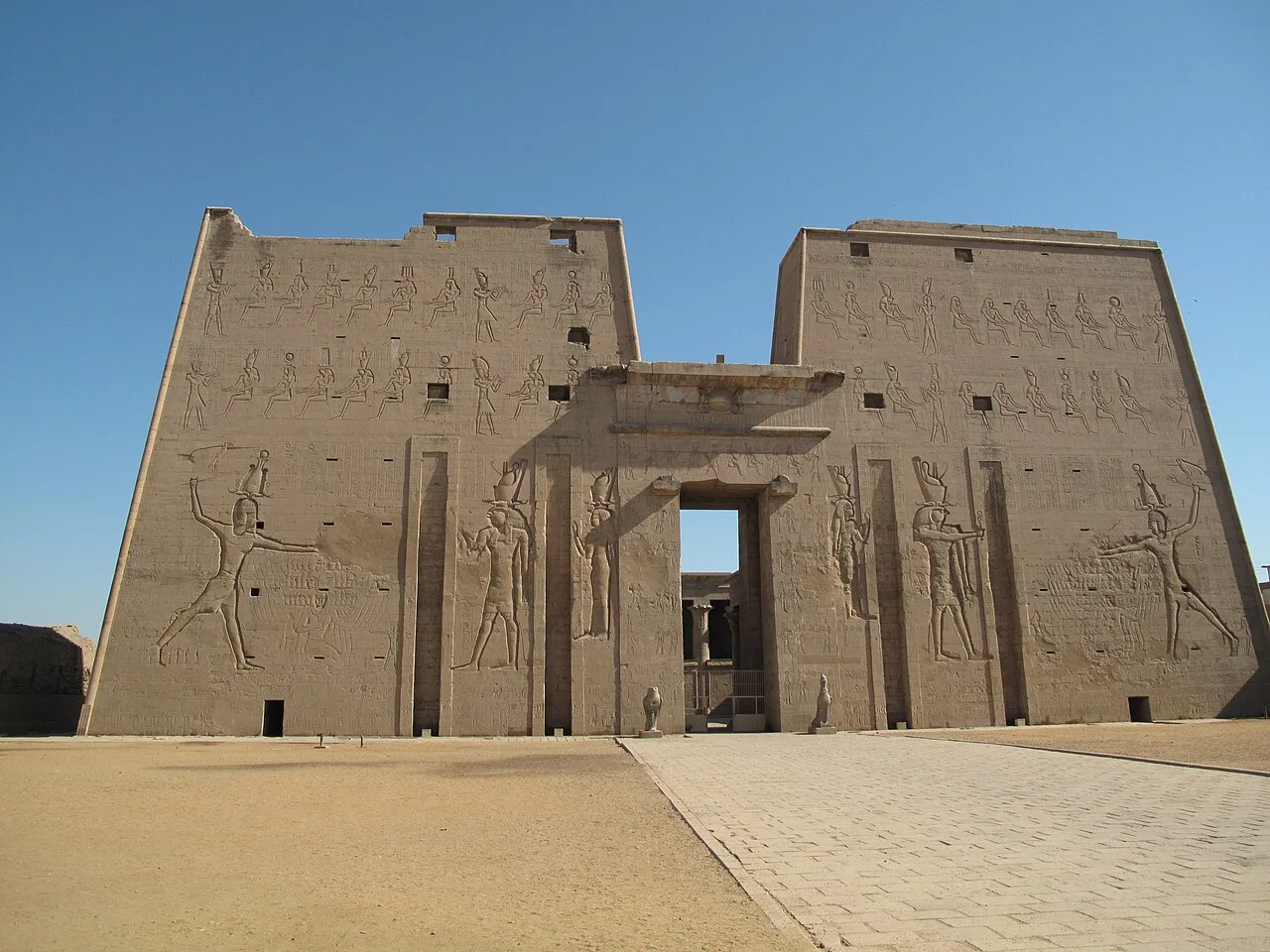
The great pylon of the Ptolemaic Temple of Horus at Edfu, Egypt

Wikimedia Commons

Country Record

Known by the Most Names in Egypt

신전

Temple of Edfu

Seyfi Cem Baskin

معبد إدفو237 기원전 – 57 기원전

The most completely preserved temple in all of Egypt — the great Temple of Horus at Edfu, built by the Ptolemies between 237 and 57 BCE. Its towering pylon, columned courts, and dark inner sanctuary survive almost intact, and its walls carry some of the most complete temple texts to come down from the ancient world.

41
관심 66

위치

이집트

24.98°N · 32.87°E · 아프리카

Built

237–57 BCE (Ptolemaic dynasty)

Dedicated to

Horus, the falcon god

Preservation

Most complete temple in Egypt; pylon ~36 m high

Excavated by

Auguste Mariette, 1860s (from beneath sand and silt)

Inscriptions

Among the fullest temple texts surviving (ritual, myth, festivals)

Size

Second-largest Egyptian temple after Karnak

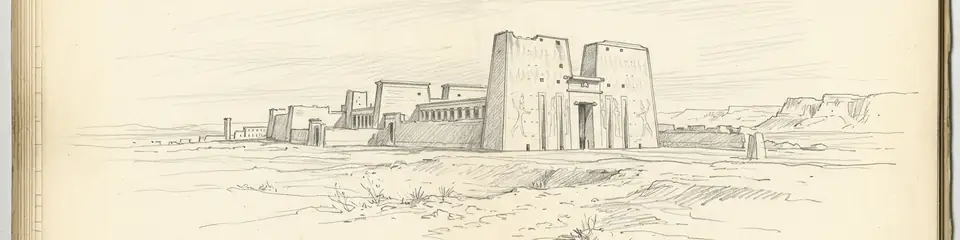
Graphite pencil sketch banner of Temple of Edfu

“The Temple of Edfu is the most complete and best-preserved temple of ancient Egypt, providing an almost intact example of what a major Egyptian temple looked like — from its towering pylon down to the shrine that held the god's image.”

위치

개요

The Temple of Edfu stands on the west bank of the Nile between Aswan and Luxor, in the town of Edfu (ancient Behdet, called Apollonopolis Magna by the Greeks). Dedicated to the falcon god Horus, it is the best-preserved major temple in Egypt and, after Karnak, the second largest. It is also one of the latest, built entirely during the Ptolemaic period — Greek-descended pharaohs ruling Egypt — between 237 BCE, under Ptolemy III, and 57 BCE, under Ptolemy XII, the father of Cleopatra VII. Despite its late date and Greek royal patrons, it was built and decorated in the fully traditional Egyptian manner.

The temple's survival is owed to the desert sand and Nile silt that buried it almost completely after the cult ended, protecting the structure from quarrying and weathering until it was excavated by the French Egyptologist Auguste Mariette in the 1860s. As a result, the building survives to an extent unmatched elsewhere: the great entrance pylon stands some 36 metres high, still decorated with colossal reliefs of the king smiting his enemies; behind it lie a colonnaded court, two hypostyle halls, and the inner sanctuary, which still contains a granite naos (shrine) and a replica of the sacred barque in which the god's image was carried. Two black-granite statues of Horus as a falcon flank the entrance.

What makes Edfu uniquely valuable to scholars is the vast quantity of inscriptions covering almost every surface. Because the temple was conceived and decorated as a single, coherent programme over roughly 180 years, its texts form one of the most complete records of Egyptian temple ritual, mythology, festivals, and even the building's own construction and dimensions. The walls record the "Myth of Horus," including the dramatic battle between Horus and his rival Seth, and the annual festivals — such as the "Sacred Marriage," when the image of the goddess Hathor travelled upriver from Dendera to be united with Horus at Edfu.

The temple functioned until the suppression of pagan worship in the Roman period; some reliefs bear deliberate damage from later iconoclasm, and soot on the hypostyle ceiling marks a period when people lived inside the buried structure.

중요성

The Temple of Edfu is the most complete and best-preserved temple of ancient Egypt, providing an almost intact example of what a major Egyptian temple looked like — from its towering pylon down to the shrine that held the god's image. Because it was built and decorated as a single coherent project over about 180 years, its inscriptions are among the fullest sources we possess for Egyptian temple ritual, mythology, festival calendars, and even the symbolic meaning and measurements of the building itself. For Egyptologists it is effectively a stone encyclopaedia of late temple religion. It is one of the most visited monuments on the Nile and part of the rich heritage landscape of Upper Egypt.

증거와 해석

확립된 사실과 논쟁 중인 사항을 구분합니다.

잘 확립된 사실

4
  • Construction dates of 237–57 BCE are fixed by the dated cartouches and building texts of successive Ptolemaic kings inscribed on the temple itself.
  • The inner sanctuary retains its granite naos and a replica processional barque, preserving the layout of the temple's holiest space — exceptional among Egyptian temples.
  • The walls carry extensive texts including the "Myth of Horus" and the temple's festival calendar (e.g. the Sacred Marriage with Hathor of Dendera), forming a near-complete ritual record.
  • Deliberate damage to certain divine figures, and soot deposits on the hypostyle ceiling, evidence later iconoclasm and a period of habitation within the buried temple.

학술적 추론

1
  • The temple's exceptional preservation is attributed to its near-total burial by wind-blown sand and Nile silt after the cult ceased, sheltering it until 19th-century excavation.

커뮤니티 사진

당신의 경험을 공유하세요

이 유적지를 방문하셨나요? 다른 탐험가들을 위해 사진을 업로드해 보세요.

이 페이지 인용 방법

Atlas Anatolia. (237). Temple of Edfu. Atlas Anatolia. https://atlasanatolia.com/ko/site/edfu

콘텐츠는 CC BY-SA 4.0 라이선스에 따라 제공됩니다 — 재사용 시 출처 표시가 필요합니다.

출처

  • The Complete Temples of Ancient Egypt — Wilkinson, Richard H. (2000)
  • The Temple of Edfu: A Guide by an Ancient Egyptian Priest — Kurth, Dieter (2004)

자주 묻는 질문

Temple of Edfu은(는) 어디에 위치해 있나요?

Temple of Edfu은(는) Egypt에 위치해 있습니다.

Temple of Edfu의 연대는 언제인가요?

Temple of Edfu의 연대는 대략 237 기원전 – 57 기원전로 거슬러 올라갑니다.

Temple of Edfu과(와) 관련된 고대 문명은 무엇인가요?

Temple of Edfu은(는) Ancient Egyptian 문명과 관련이 있습니다.

Temple of Edfu이(가) 중요한 이유는 무엇인가요?

The Temple of Edfu is the most complete and best-preserved temple of ancient Egypt, providing an almost intact example of what a major Egyptian temple looked like — from its towering pylon down to the shrine that held the god's image.

Temple of Edfu은(는) 유네스코 세계유산인가요?

Temple of Edfu은(는) 현재 유네스코 세계유산 목록에 등재되어 있지 않습니다.