
Aller au contenu
Atlas Anatolia
ActualitésIce Age teeth in Sulawesi push betel-nut use back as far as 25,000 yearsRoman mosaic and Eros head uncovered in the basilica at Pompeiopolis, Kastamonu
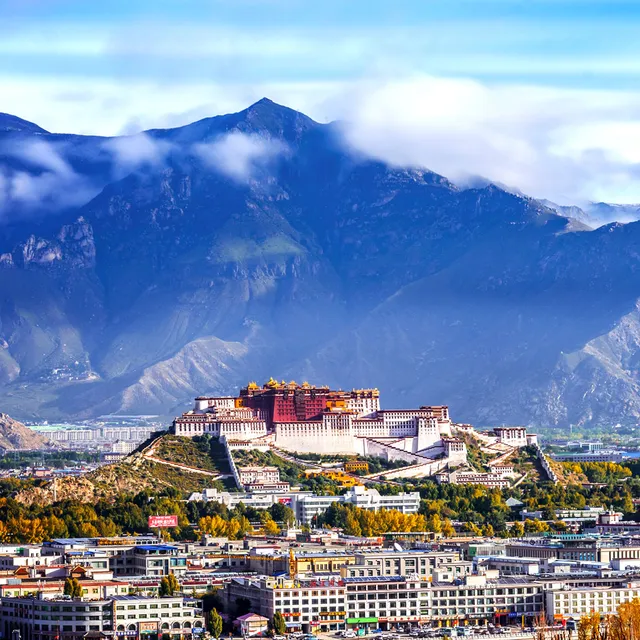
The Potala Palace on Red Hill above Lhasa, Tibet

Wikimedia Commons

Country Record

Known by the Most Names in China

PatrimoineComplexeUNESCOEn vedette

Potala Palace

Seyfi Cem Baskin

པོ་ཏ་ལ637 apr. J.-C. – 1959 apr. J.-C.

The fortress-palace rising 13 storeys on Red Mountain above Lhasa — winter residence of the Dalai Lamas since the 7th century and symbol of Tibetan Buddhism — whose white and red wings, golden roofs, and chapels dominate the Himalaya skyline at 3,700 metres.

21
Intérêt 78

Localisation

Chine

29.66°N · 91.12°E · Asie

Elevation

~3,700 m above sea level on Red Hill

Height

13 storeys; over 1,000 rooms (traditional count)

Major rebuild

17th century under the Fifth Dalai Lama

UNESCO

Historic Ensemble of the Potala Palace (1994)

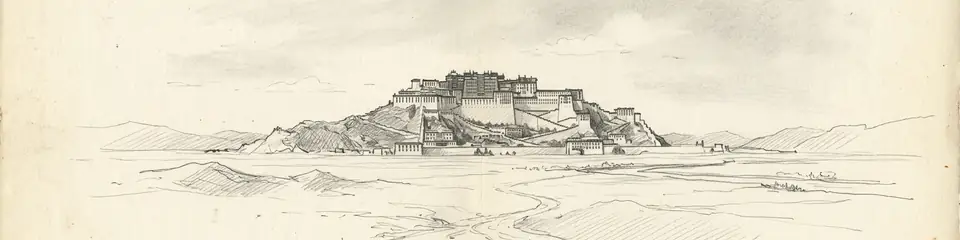
Graphite pencil sketch banner of Potala Palace

“The Potala is the supreme architectural expression of Tibetan Buddhist governance — a palace-temple whose scale and altitude embody the unique fusion of spiritual and temporal authority in the Himalaya.”

Localisation

Aperçu

The Potala Palace crowns Marpo Ri (Red Hill) in the centre of the Lhasa Valley, Tibet Autonomous Region, China, at roughly 3,700 metres elevation. Tradition associates the hill with Songtsen Gampo (7th century), who built a palace for his marriage alliances; the present monumental complex largely reflects the 17th-century reconstruction under the Fifth Dalai Lama, Ngawang Lobsang Gyatso, with major expansion continuing under the Thirteenth Dalai Lama.

The White Palace (Phodrang Karpo) contains the Dalai Lama's residential and administrative quarters; the Red Palace (Phodrang Marpo) houses chapels, stupas of successive Dalai Lamas, and assembly halls dense with murals, thangkas, and gilded tombs. The building integrates fortress walls, sloping stone foundations, and timber superstructure engineered for seismic and alpine conditions.

The UNESCO Historic Ensemble of the Potala Palace, Lhasa (1994, extended 2000–2001) also includes Jokhang Temple and Norbulingka summer palace. The Potala remains among the most photographed monuments in Asia and a focal point of Tibetan cultural identity.

Pourquoi c'est important

The Potala is the supreme architectural expression of Tibetan Buddhist governance — a palace-temple whose scale and altitude embody the unique fusion of spiritual and temporal authority in the Himalaya. Its 1994 UNESCO listing anchored international recognition of Tibetan heritage conservation at a moment of rapid modernisation in Lhasa.

Preuves et interprétation

Distinguer ce qui est bien établi de ce qui reste débattu.

Faits bien établis

2
  • Tibetan chronicles and copper inscriptions document 17th-century expansion under the Fifth Dalai Lama and subsequent Dalai Lama burials in the Red Palace.
  • Architectural survey confirms layered timber–masonry construction, sloping batter walls, and chapel layouts typical of Ganden Phodrang-period building.

Inférences savantes

1
  • Early 7th-century occupation of Red Hill by Songtsen Gampo is supported by tradition and limited archaeology; extent of his original structure is uncertain.

Photos de la communauté

Partagez votre expérience

Avez-vous visité ce site ? Téléchargez vos photos pour aider les autres à le découvrir.

Comment citer cette page

Atlas Anatolia. (637). Potala Palace. Atlas Anatolia. https://atlasanatolia.com/fr/site/potala-palace

Contenu sous licence CC BY-SA 4.0 — attribution requise en cas de réutilisation.

Sources

  • The Temples of Lhasa — Alexander, André (2005)
  • UNESCO — Potala PalaceLien

Questions fréquentes

Où se trouve Potala Palace ?

Potala Palace est situé à/en China.

De quand date Potala Palace ?

Potala Palace remonte approximativement à 637 apr. J.-C. – 1959 apr. J.-C..

Quelles civilisations sont associées à Potala Palace ?

Potala Palace est associé à la civilisation Tibetan.

Pourquoi Potala Palace est-il important ?

The Potala is the supreme architectural expression of Tibetan Buddhist governance — a palace-temple whose scale and altitude embody the unique fusion of spiritual and temporal authority in the Himalaya.

Potala Palace est-il inscrit au patrimoine mondial de l'UNESCO ?

Oui — Potala Palace est inscrit sur la liste du patrimoine mondial de l'UNESCO.