
Saltar al contenido
Atlas Anatolia
NoticiasIce Age teeth in Sulawesi push betel-nut use back as far as 25,000 yearsRoman mosaic and Eros head uncovered in the basilica at Pompeiopolis, Kastamonu
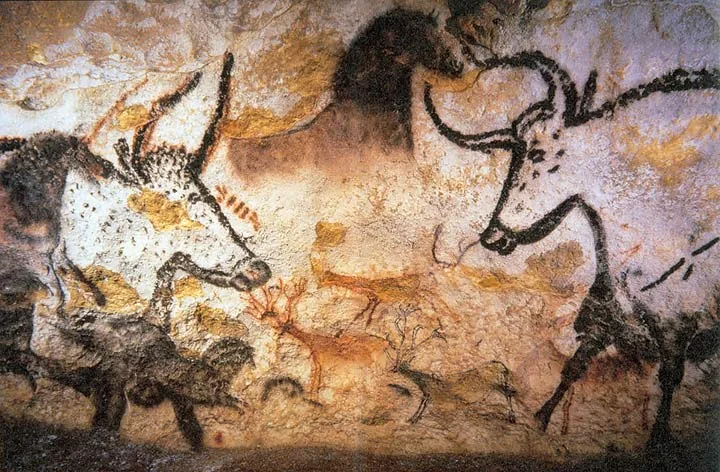
Paleolithic paintings of horses in the Hall of the Bulls, Lascaux

Wikimedia Commons

Récord nacional

Oldest Sanctuary in France

SantuarioUNESCODestacado

Lascaux

Seyfi Cem Baskin

Grotte de Lascaux17000 a. C. – 13000 a. C.

A Paleolithic cave near Montignac, France, containing some of the finest figurative paintings in human history — approximately 600 paintings and 1,500 engravings created c. 17,000 BCE by Magdalenian hunter-gatherers.

211
Interés 76

Ubicación

Francia

45.05°N · 1.08°E · Europa

Date of paintings

c. 17,000–15,000 BCE

Images

~600 paintings and 1,500 engravings

Discovery

12 September 1940

Closed to public

1963 (algae and fungal damage from CO₂)

Replica (Lascaux IV)

Opened 2016, full-scale cave replica

UNESCO

World Heritage Site (Vézère Valley) since 1979

Graphite pencil sketch banner of Lascaux

Lascaux demonstrates that the cognitive capacity for complex representational art — accurate naturalistic depiction of movement, overlapping perspective, composite scenes — was fully developed in humans at least 17,000 years ago, and probably much earlier.”

Ubicación

Resumen

Lascaux is a cave system in the Vézère Valley, Dordogne, southwestern France, 1.5 km north of the village of Montignac. It was discovered on 12 September 1940 by four teenagers following a fox into a shaft. The cave contains approximately 600 paintings and 1,500 engravings covering a total surface area of roughly 250 square meters. The images — dated to c. 17,000–15,000 BCE by radiocarbon dating of charcoal and by thermoluminescence dating of flint tools — depict horses (the most numerous subject), aurochs, stags, bison, bears, a rhinoceros, a bird, and a unique scene (the "Shaft Scene") showing a bird-headed human figure alongside a wounded bison and a rhinoceros. The pigments used were mineral-based — ochre, iron oxide, manganese dioxide, charcoal — mixed with animal fat and applied with pads, brushes, and by blowing through tubes. Some images exploit the natural relief of the rock to create three-dimensional illusions. Lascaux was opened to the public in 1948 but was closed in 1963 after the CO₂ and humidity from visitors' breath caused the growth of algae and fungi across the paintings. A precise replica (Lascaux II) opened 200 m from the original cave in 1983; an enhanced full-cave replica (Lascaux IV) opened in 2016.

Por qué es importante

Lascaux demonstrates that the cognitive capacity for complex representational art — accurate naturalistic depiction of movement, overlapping perspective, composite scenes — was fully developed in humans at least 17,000 years ago, and probably much earlier. The paintings are not primitive: the aurochs at Lascaux are rendered with an understanding of animal anatomy and movement that would not be surpassed for millennia. The "Shaft Scene" — a man, a bird, a wounded bison, and a rhinoceros — is the oldest known narrative scene in human art, possibly depicting a hunt, a myth, or a vision. The decision to close Lascaux to public access in 1963 — the first time a major heritage site was closed to protect it — established a precedent for conservation over tourism that shaped policy worldwide.

Evidencia e interpretación

Distinguir lo bien establecido de lo que sigue en debate.

Hechos bien establecidos

2
  • Radiocarbon dating of charcoal fragments associated with the paintings and accelerator mass spectrometry dating of organic material in the pigments gives a date range of c. 17,000–15,000 BCE for the main painted sequences.
  • Mineral analysis of the pigments confirms they are ochre (yellow and red iron oxides), manganese dioxide (black), and charcoal, consistent with known Magdalenian pigment technology. No organic binders survive, but fats and oils are assumed from ethnographic parallels.

Inferencias académicas

1
  • The "Shaft Scene" — the only narrative composition at Lascaux, showing a wounded bison, a bird-headed human, and a rhinoceros — is interpreted by most scholars as depicting a hunting accident or shamanic vision, but the exact meaning is unknown.

Interpretaciones debatidas

1
  • Several researchers have proposed that some compositions at Lascaux represent star maps or seasonal astronomical charts, based on claimed correspondences between animal groupings and constellations. This interpretation is not accepted by mainstream archaeoastronomers.

Fotos de la comunidad

Comparte tu experiencia

¿Has visitado este sitio? Sube tus fotos para ayudar a otros a descubrirlo.

Cómo citar esta página

Atlas Anatolia. (17000). Lascaux. Atlas Anatolia. https://atlasanatolia.com/es/site/lascaux

Contenido bajo licencia CC BY-SA 4.0 — se requiere atribución al reutilizar.

Fuentes

  • Lascaux: The Final PhotographsMario Ruspoli (1987)
  • Ministère de la Culture — LascauxEnlace

Preguntas frecuentes

¿Dónde se encuentra Lascaux?

Lascaux se encuentra en France.

¿Qué antigüedad tiene Lascaux?

Lascaux se fecha aproximadamente en 17000 a. C. – 13000 a. C..

¿Por qué es importante Lascaux?

Lascaux demonstrates that the cognitive capacity for complex representational art — accurate naturalistic depiction of movement, overlapping perspective, composite scenes — was fully developed in humans at least 17,000 years ago, and probably much earlier.

¿Lascaux es Patrimonio Mundial de la UNESCO?

Sí. Lascaux está inscrito en la Lista del Patrimonio Mundial de la UNESCO.