
Saltar al contenido
Atlas Anatolia
NoticiasIce Age teeth in Sulawesi push betel-nut use back as far as 25,000 yearsRoman mosaic and Eros head uncovered in the basilica at Pompeiopolis, Kastamonu
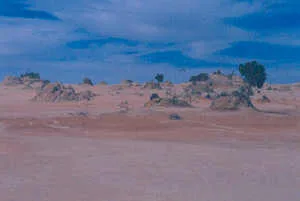
The eroded dune formations known as the Walls of China at Lake Mungo, New South Wales, Australia

Wikimedia Commons

Récord mundial

Oldest Settlement in the World

AsentamientoUNESCO

Lake Mungo

Seyfi Cem Baskin

42000 a. C. – 14000 a. C.

A dry lakebed in remote southwestern New South Wales that holds the oldest confirmed human remains outside Africa — the 40,000-year-old skeletons known as Mungo Man and Mungo Lady, whose burials rank among the earliest evidence anywhere of deliberate cremation and ochre burial ritual. The eroding dune formations known as the Walls of China continue to expose new archaeological material, making Lake Mungo one of the most continuously important sites in the study of early human migration into Australia.

41
Interés 52

Ubicación

New South Wales · Australia

33.73°S · 143.08°E · Oceanía

Mungo Lady

Discovered 1968 — oldest known cremation burial in the world, c. 40,000 years ago

Mungo Man

Discovered 1974 — ochre-covered burial, c. 40,000–42,000 years ago

Footprints

Willandra Lakes Trackway — 700+ footprints preserved in ancient lakebed clay, c. 20,000 years old

Significance

Oldest confirmed anatomically modern human remains found outside Africa

UNESCO

Willandra Lakes Region, World Heritage Site 1981

Graphite pencil sketch banner of Lake Mungo

Lake Mungo anchors the timeline of human presence on the Australian continent and, by extension, the story of when and how anatomically modern humans first left Africa and spread across Asia and Oceania.”

Ubicación

Resumen

Lake Mungo is one of a chain of now-dry lakebeds in the Willandra Lakes Region of far southwestern New South Wales, Australia. Between roughly 50,000 and 19,000 years ago, the lake held water fed by the Willandra Creek, supporting a rich lakeside ecosystem of fish, shellfish, and waterfowl that in turn sustained sustained human occupation for tens of thousands of years before the lake system dried permanently as the climate shifted at the end of the last glacial period.

Along the lake's eastern shore, wind erosion has carved a spectacular 33-kilometre crescent of dunes known as the Walls of China, exposing layered sediments that have preserved an extraordinarily long and continuous archaeological record. In 1968, geologist Jim Bowler discovered cremated human remains eroding from these dunes — a find that came to be known as Mungo Lady (formally Lake Mungo 1, or LM1). Further analysis showed her body had been cremated, the bones crushed, and then reburied — the oldest known cremation anywhere in the world. In 1974, Bowler discovered a second skeleton nearby, Mungo Man (LM3), an adult male buried on his back with his hands crossed over his groin, his body sprinkled with red ochre transported from a source many kilometres away — among the oldest known instances of ochre burial ritual in the world.

Dating the Mungo remains has been a long and contested scientific process spanning several decades and multiple dating techniques, including radiocarbon, thermoluminescence, electron spin resonance, and uranium-series dating. Current consensus places Mungo Man's burial at approximately 40,000–42,000 years ago, though some researchers have argued for dates as early as 60,000 years. Regardless of the exact figure, the Mungo remains represent the oldest confirmed anatomically modern human remains found outside Africa, and among the earliest reliably dated evidence of ritual burial practice anywhere on Earth.

Beyond the two named burials, the Willandra Lakes shorelines have yielded an immense assemblage of stone tools, hearths, shell middens, and the fossilised footprints of the Willandra Lakes Trackway — a set of more than 700 human footprints preserved in a former claypan, made by a group of people, including children, running and walking across the wet lakebed mud roughly 20,000 years ago. The site continues to actively erode, exposing new material each year, which has made ongoing collaboration between archaeologists and the Barkindji, Ngyiampaa, and Mutthi Mutthi Traditional Owners central to the site's management. Following sustained advocacy from these communities, Mungo Man's and Mungo Lady's remains — removed for study in the 1970s — were formally returned to Traditional Owner custody in 2017 and reburied within the Willandra Lakes Region in 2022. The Willandra Lakes Region was inscribed as a UNESCO World Heritage Site in 1981.

Por qué es importante

Lake Mungo anchors the timeline of human presence on the Australian continent and, by extension, the story of when and how anatomically modern humans first left Africa and spread across Asia and Oceania. A confirmed human presence in Australia by 40,000+ years ago means humans successfully crossed at least 90 kilometres of open water — even during the lowest Ice Age sea levels, Australia was never connected to Southeast Asia by a land bridge — implying deliberate seafaring capability far earlier than once assumed. The ritual sophistication of the Mungo burials — cremation, ochre application, deliberate body positioning — pushes back the archaeological evidence for symbolic and ritual behaviour in the human story by tens of thousands of years, at a site far removed from the traditionally studied core regions of early human symbolic culture in Africa and Europe. Lake Mungo also stands as a model for the return of ancestral remains to Indigenous custodianship. The decades-long process that led to Mungo Man's and Mungo Lady's reburial reshaped how Australian archaeology engages with Traditional Owners, establishing a template now referenced in repatriation debates worldwide.

Evidencia e interpretación

Distinguir lo bien establecido de lo que sigue en debate.

Hechos bien establecidos

4
  • Multiple independent dating methods (optically stimulated luminescence, uranium-series, electron spin resonance) converge on an age of approximately 40,000–42,000 years for the Mungo Man burial.
  • Microscopic and chemical analysis of the Mungo Lady remains confirmed cremation followed by deliberate crushing and reburial of the bones, the earliest documented cremation ritual known anywhere.
  • Red ochre residue on the Mungo Man skeleton has been sourced to deposits located many kilometres from the burial site, indicating deliberate transport of ritual material.
  • The Willandra Lakes Trackway footprints were dated using optically stimulated luminescence on the enclosing sediment layers to approximately 19,000–23,000 years ago.

Interpretaciones debatidas

1
  • Some researchers have proposed dates for the earliest Willandra Lakes occupation as old as 60,000 years, based on differing sediment dating interpretations; this remains contested against the more widely accepted 40,000–50,000 year range.

Descubrimiento y excavación

1968

Discovery of Mungo Lady

Geologist Jim Bowler discovers cremated human remains eroding from the Walls of China dune formation.

1974

Discovery of Mungo Man

Bowler discovers a second, more complete skeleton nearby, an adult male buried with red ochre application.

2003

Willandra Lakes Trackway excavation

Systematic excavation and dating of the fossilised human footprint trackway discovered in the Willandra Lakes claypans.

2017–2022

Repatriation and reburial

Mungo Man and Mungo Lady are returned to Traditional Owner custody in 2017 and formally reburied within the Willandra Lakes Region in 2022.

Fotos de la comunidad

Comparte tu experiencia

¿Has visitado este sitio? Sube tus fotos para ayudar a otros a descubrirlo.

Cómo citar esta página

Atlas Anatolia. (42000). Lake Mungo. Atlas Anatolia. https://atlasanatolia.com/es/site/lake-mungo

Contenido bajo licencia CC BY-SA 4.0 — se requiere atribución al reutilizar.

Fuentes

  • New ages for human occupation and climatic change at Lake Mungo, AustraliaBowler, Jim M. et al. (2003)
  • Ancient DNA and the return of Mungo Man's ancestral remainsWestaway, Michael C. et al. (2017)
  • UNESCO — Willandra Lakes RegionEnlace

Preguntas frecuentes

¿Dónde se encuentra Lake Mungo?

Lake Mungo se encuentra en New South Wales, Australia.

¿Qué antigüedad tiene Lake Mungo?

Lake Mungo se fecha aproximadamente en 42000 a. C. – 14000 a. C..

¿Qué civilizaciones se relacionan con Lake Mungo?

Lake Mungo se relaciona con Aboriginal Australian.

¿Por qué es importante Lake Mungo?

Lake Mungo anchors the timeline of human presence on the Australian continent and, by extension, the story of when and how anatomically modern humans first left Africa and spread across Asia and Oceania.

¿Lake Mungo es Patrimonio Mundial de la UNESCO?

Sí. Lake Mungo está inscrito en la Lista del Patrimonio Mundial de la UNESCO.