
Saltar al contenido
Atlas Anatolia
NoticiasIce Age teeth in Sulawesi push betel-nut use back as far as 25,000 yearsRoman mosaic and Eros head uncovered in the basilica at Pompeiopolis, Kastamonu
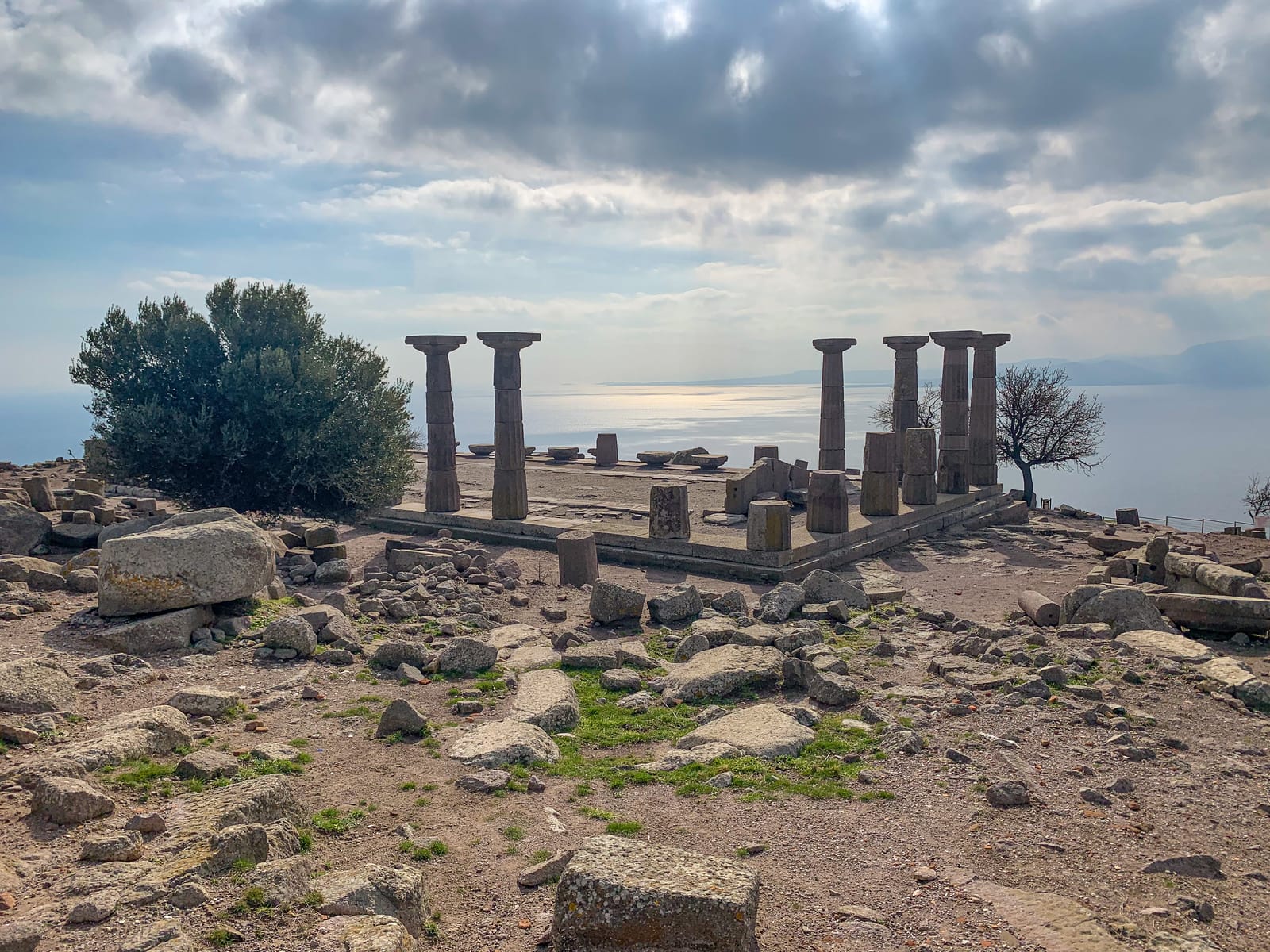
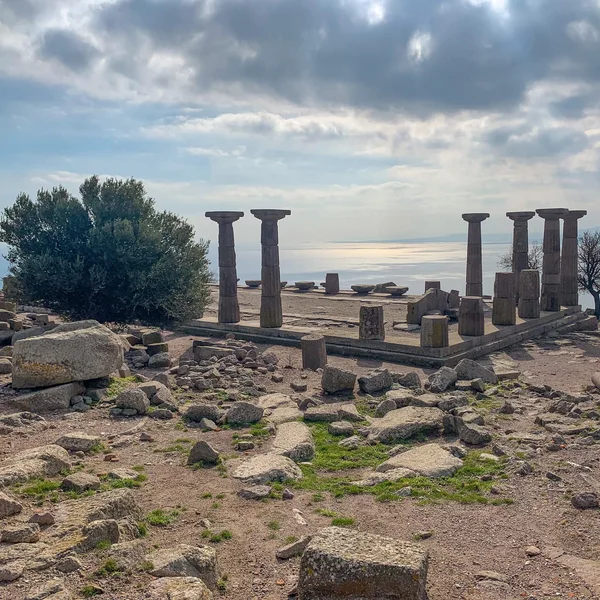
Temple of Athena at Assos overlooking the Aegean Sea

Wikimedia Commons (CC BY-SA)

CiudadDestacado

Assos

Seyfi Cem Baskin

Behramkale900 a. C. – 500 d. C.

Where Aristotle established his philosophical school and the Temple of Athena commands breathtaking views over the Aegean to Lesbos. Assos combines intellectual heritage with one of Anatolia's most dramatic coastal settings.

312
Interés 57

Ubicación

Canakkale · Marmara · Turquía

39.49°N · 26.34°E · Asia

Aristotle's Residence

347-344 BCE

Temple of Athena

Only Archaic Doric temple in Asia Minor (c. 530 BCE)

Elevation

238 meters above sea level

Fortification

3+ km of intact ancient city walls

Notable Finds

A 4th-century BCE sarcophagus depicting a symposium scene, discovered in the necropolis.

Dating Method

Pottery and architectural styles, including black-figure pottery, confirm the Archaic and Classical settlement phases.

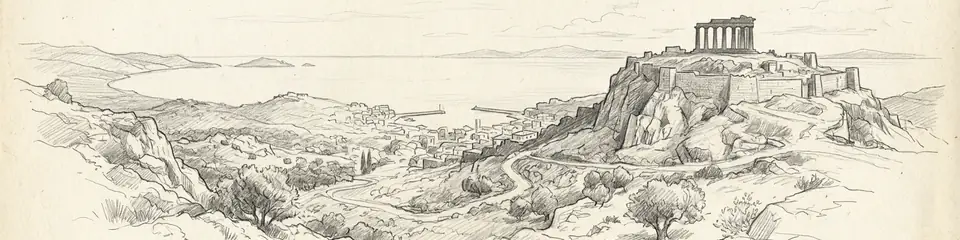
Graphite pencil sketch banner of Assos

Assos is where philosophy met the natural world.”

De Wikipedia

Assos is an ancient Greek city in the Troad region of Anatolia, known for its Temple of Athena and as the place where Aristotle established a philosophical school.

Leer el artículo completo en Wikipedia

Ubicación

Resumen

Assos occupies a steep volcanic promontory overlooking the Aegean Sea, with the Greek island of Lesbos visible across the strait. Founded by Aeolian colonists from Methymna on Lesbos around 900 BCE, the city rose to prominence in the 4th century BCE when the philosopher Aristotle lived here from 347 to 344 BCE, establishing a school and conducting some of his foundational studies of biology and zoology using specimens from the surrounding coastline.

The Temple of Athena, perched on the acropolis at 238 meters above sea level, is the only archaic Doric temple in Asia Minor. Built around 530 BCE, its surviving columns frame panoramic views of the Aegean — one of the most photographed archaeological vistas in Turkey.

"Assos is a city of the Troad, on the Adramyttene Gulf, opposite to the island of Lesbos."
— Strabo, c. 7 BCE - 23 CE

The city retains a remarkably complete urban plan, including a terraced agora (one of the best-preserved in the Greek world), a Hellenistic theatre, gymnasium, bouleuterion, and extensive necropolis with elaborately carved sarcophagi. The fortification walls, stretching over three kilometers, are among the most complete ancient city walls in Anatolia.

The ancient harbor below the acropolis — now the village of Behramkale — remains an active fishing port, preserving a continuity of maritime use spanning nearly three millennia.
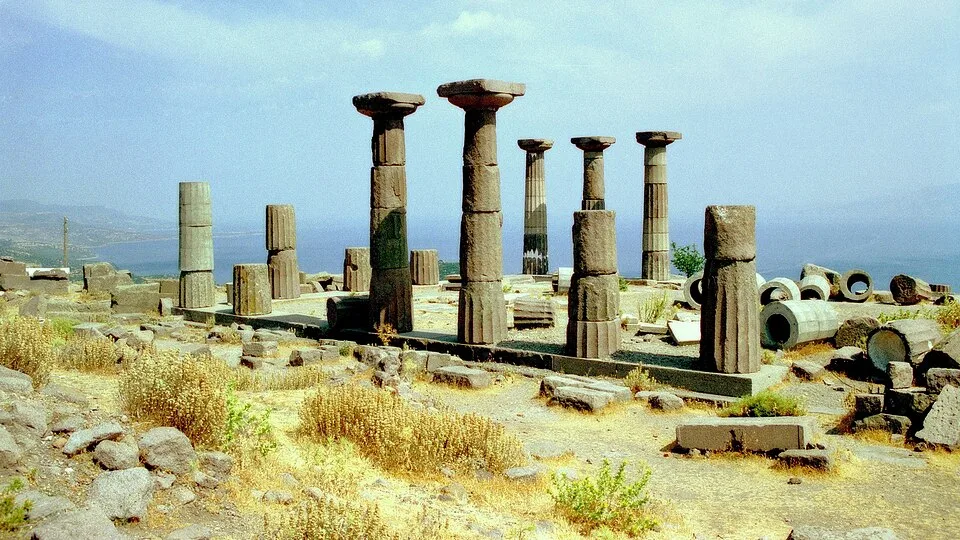
Assos (1995) 19 (7902773580)
Assos (1995) 19 (7902773580) | Carl Campbell from Santiago de Querétaro, México (CC BY 2.0)

The city's urban fabric reveals a sophisticated infrastructure. A well-preserved 3rd-century BCE gymnasium complex, complete with palaestra and baths, attests to the importance of education and physical training. The extensive necropolis sprawling down the southern slopes features monumental sarcophagi, some with intricate reliefs depicting scenes of daily life and mythology, offering profound insights into funerary art and social status. Assos was a significant port, its economy fueled by local resources like andesite stone, quarried and exported for millstones, and agricultural products from its fertile hinterland. The city's decline began in the Byzantine era, its strategic acropolis later fortified with medieval walls, before it was largely abandoned by the 17th century CE.

Por qué es importante

Assos is where philosophy met the natural world. Aristotle's years here were formative: his biological observations of marine life in the strait between Assos and Lesbos laid the groundwork for his zoological treatises, arguably the beginning of systematic natural science. The Temple of Athena represents a unique architectural moment — the only Doric temple built in Asia Minor during the Archaic period, suggesting strong cultural connections with mainland Greece at a time when Ionic architecture dominated the eastern Aegean.

Evidencia e interpretación

Distinguir lo bien establecido de lo que sigue en debate.

Hechos bien establecidos

3
  • Aristotle resided at Assos from 347 to 344 BCE under the patronage of the ruler Hermias, as documented by multiple ancient sources including Strabo and Diogenes Laertius.
  • The Temple of Athena dates to approximately 530 BCE based on architectural analysis, making it the only known Archaic Doric temple in Anatolia.
  • The agora complex at Assos is one of the earliest and best-preserved examples of a Hellenistic stoa-enclosed public square.

Inferencias académicas

1
  • Aristotle's biological studies conducted at Assos and nearby Lesbos likely contributed to his works Historia Animalium and De Partibus Animalium.

Interpretaciones debatidas

2
  • Whether Aristotle's departure from Assos was voluntary or forced by the Persian capture and execution of Hermias in 341 BCE remains uncertain.
  • The precise function of the large, well-preserved Hellenistic bouleuterion (council house) on the agora, whether purely political or also used for philosophical teaching, is debated.

Descubrimiento y excavación

1881–1883

Archaeological Institute of America excavations

Dirigido por Joseph Thacher Clarke

Joseph Thacher Clarke led the first systematic excavations of the Temple of Athena and agora.

1881

First American Excavations

Dirigido por Francis H. Bacon and Joseph T. Clarke for the Archaeological Institute of America

The first systematic excavations at Assos were conducted by the Archaeological Institute of America, directed by Francis H. Bacon and Joseph T. Clarke, focusing on the Temple of Athena and city walls.

1981–2006

Turkish excavations

Dirigido por Umit Serdaroglu

Umit Serdaroglu of Istanbul University conducted long-term excavations uncovering the agora, theatre, and necropolis.

2006

Ongoing research

Dirigido por Nurettin Arslan

Nurettin Arslan of Canakkale Onsekiz Mart University continued excavations and conservation work.

Fotos de la comunidad

Comparte tu experiencia

¿Has visitado este sitio? Sube tus fotos para ayudar a otros a descubrirlo.

Cómo citar esta página

Atlas Anatolia. (900). Assos. Atlas Anatolia. https://atlasanatolia.com/es/site/assos

Contenido bajo licencia CC BY-SA 4.0 — se requiere atribución al reutilizar.

Leer el artículo completo en World History Encyclopedia
World History Encyclopedia · CC BY-NC-SA

Fuentes

  • Assos: An Archaeological GuideNurettin Arslan (2010)
  • Investigations at AssosJoseph Thacher Clarke (1898)
  • Wikipedia — AssosEnlace

Preguntas frecuentes

¿Dónde se encuentra Assos?

Assos se encuentra en Canakkale, Marmara, Türkiye.

¿Qué antigüedad tiene Assos?

Assos se fecha aproximadamente en 900 a. C. – 500 d. C..

¿Qué civilizaciones se relacionan con Assos?

Assos se relaciona con Greek, Roman.

¿Por qué es importante Assos?

Assos is where philosophy met the natural world.

¿Assos es Patrimonio Mundial de la UNESCO?

Assos no está inscrito actualmente en la Lista del Patrimonio Mundial de la UNESCO.