


Overview
The Temple of Heaven (Tiantan) occupies a walled park of about 273 hectares in the Dongcheng district of Beijing, south of the Forbidden City along the city's central axis. The Yongle Emperor of the Ming dynasty created the complex in the early 15th century as a counterpart to his new imperial palace: where the Forbidden City was the emperor's earthly residence, Tiantan was where he performed rites as Son of Heaven.
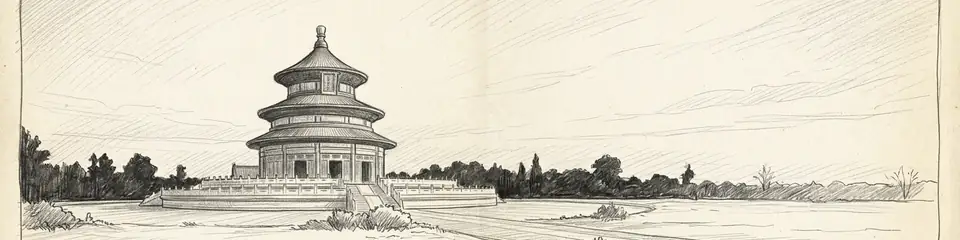
The architectural climax is the Hall of Prayer for Good Harvests (Qinian Dian), a triple-gabled circular wooden hall raised on a three-tier marble terrace, rebuilt in its present form after a lightning fire in 1889. The emperor prayed here at the winter solstice for abundant harvests. To the south, the Circular Mound Altar (Huanqiu Tan) and the Imperial Vault of Heaven (Huangqiong Yu) served complementary rituals connecting square earth and round heaven.
Qing rulers maintained and adjusted the rites until the abdication of 1912. The park opened to the public in 1918 and became a UNESCO World Heritage Site in 1998 as part of a serial inscription with the Forbidden City and Summer Palace. Morning tai chi among cypress trees and the sight of the blue-roofed hall against Beijing smog or snow make it one of China's most photographed monuments.