
Skip to content
Atlas AnatoliaAtlas Anatolia
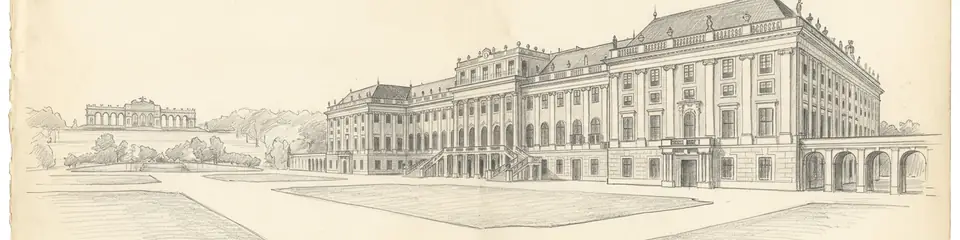
The yellow façade and gardens of Schönbrunn Palace, Vienna

Wikimedia Commons (CC BY-SA 4.0)

HeritageComplexUNESCO

Schönbrunn Palace

Schloss Schönbrunn1696 CE – 1918 CE

The Habsburg summer palace in Vienna — 1,441 rooms, formal gardens, and the Gloriette viewpoint — ranks among the most searched palaces in German and Chinese Wikipedia and rivals Versailles for Baroque court spectacle.

21
Interest 79

Location

Austria

48.18°N · 16.31°E · Europe

Rooms

1,441; state rooms open to visitors

Maria Theresa

Major Baroque remodelling 1740s–50s

Gloriette

Colonnade viewpoint above formal gardens

UNESCO

Palace and Gardens of Schönbrunn (1996)

Schönbrunn condenses Habsburg imperial history — Maria Theresa, Mozart, Franz Joseph, and the end of empire — into one Baroque ensemble.”

Location

Overview

Schönbrunn Palace stands in Hietzing, Vienna, Austria, on the site of a hunting lodge the Habsburgs expanded after the failed 1683 Ottoman siege. Empress Maria Theresa remodelled the palace in the 1740s–50s into the chief summer residence of the Austrian monarchy. Johann Bernhard Fischer von Erlach and Nicolaus Pacassi shaped the yellow façade stretching 180 metres.

State rooms include the Great Gallery where Mozart performed as a child and where metternich-era diplomacy unfolded. The gardens feature the Neptune Fountain, Roman Ruin folly, maze, and the Gloriette colonnade on the hill. Franz Joseph was born and died here; the last Habsburg emperor Karl I signed his abdication in 1918.

UNESCO inscribed the Palace and Gardens of Schönbrunn in 1996. Visitor numbers rank among Europe's highest for historic houses. The zoo (Tiergarten) on the grounds is the world's oldest continuously operating menagerie.

Why It Matters

Schönbrunn condenses Habsburg imperial history — Maria Theresa, Mozart, Franz Joseph, and the end of empire — into one Baroque ensemble. Its German-language search dominance makes it essential for a multilingual atlas serving DE audiences.

Stay curious

New stories and sites, once a month. No spam.

Evidence & Interpretation

Distinguishing what is well-established from what remains debated.

Well-Established Facts

2
  • Habsburg court records and Fischer von Erlach plans document 18th-century rebuilding campaigns.
  • Franz Joseph's birth (1830) and death (1916) at Schönbrunn recorded in imperial chronicles.

Scholarly Inferences

1
  • Garden axes align with Baroque triumphal symbolism — Gloriette frames palace as hilltop exedra.

More Photos

Museum Artifacts

Community Photos

Share your experience

Have you visited this site? Upload your photos to help others discover it.

How to cite this page

Atlas Anatolia. (1696). Schönbrunn Palace. Atlas Anatolia. https://atlasanatolia.com/site/schonbrunn-palace

Content licensed CC BY-SA 4.0 — attribution required when reusing.

Sources

  • Music and Spectacle in Baroque RomeHammond, Frederick (1994)
  • UNESCO — Palace and Gardens of SchönbrunnLink

Research Papers

Frequently Asked Questions

Where is Schönbrunn Palace located?

Schönbrunn Palace is located in Austria.

How old is Schönbrunn Palace?

Schönbrunn Palace dates to approximately 1696 CE – 1918 CE.

Which civilizations are associated with Schönbrunn Palace?

Schönbrunn Palace is associated with the Habsburg.

Why is Schönbrunn Palace important?

Schönbrunn condenses Habsburg imperial history — Maria Theresa, Mozart, Franz Joseph, and the end of empire — into one Baroque ensemble.

Is Schönbrunn Palace a UNESCO World Heritage Site?

Yes — Schönbrunn Palace is inscribed as a UNESCO World Heritage Site.