Pular para o conteúdo
Atlas Anatolia
NotíciasIce Age teeth in Sulawesi push betel-nut use back as far as 25,000 yearsRoman mosaic and Eros head uncovered in the basilica at Pompeiopolis, Kastamonu
Temple of Concordia in the Valley of the Temples, Agrigento

Wikimedia Commons (CC BY-SA 3.0)

Country Record

Known by the Most Names in Italy

SantuárioUNESCODestaque

Valley of the Temples

Seyfi Cem Baskin

Valle dei Templi580 a.C. – 200 a.C.

The Doric ridge of ancient Akragas — Concordia, Juno, Heracles, and Zeus among the best-preserved Greek temples outside the Aegean — is Sicily’s premier classical archaeological landscape.

21
Interesse 49

Localização

Itália

37.29°N · 13.59°E · Europa

Founded

c. 580 BCE (Geloan colony)

Signature temple

Concordia — among best-preserved Doric

Olympieion

Unfinished temple of Zeus with atlases

UNESCO

Inscribed 1997

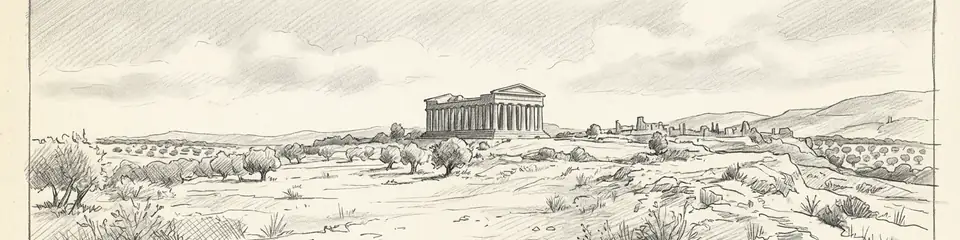
Graphite pencil sketch banner of Valley of the Temples

“Agrigento concentrates western Greek monumental religion at a scale unmatched elsewhere in Sicily and rare even in mainland Greece.”

Localização

Visão geral

The Valley of the Temples occupies a sandstone ridge south of modern Agrigento (ancient Akragas / Agrigentum) on Sicily’s southern coast. Founded by Geloan colonists c. 580 BCE, Akragas became one of the richest Greek cities of the west. In the 5th century BCE its tyrants and citizens raised a line of monumental Doric temples along the city’s southern wall — today named for Concordia, Juno Lacinia, Heracles, Olympian Zeus (the unfinished Olympieion with giant atlas figures), Castor and Pollux, and Vulcan.

The Temple of Concordia is among the best-preserved Doric temples anywhere, owing to its medieval conversion into a church. Excavation and anastylosis from the 18th century onward, and the modern archaeological park, make the ridge a continuous outdoor museum. UNESCO inscribed the area in 1997. Pair with Paestum and the Acropolis of Athens for complementary Doric sacred landscapes.
Por que isso importa

Agrigento concentrates western Greek monumental religion at a scale unmatched elsewhere in Sicily and rare even in mainland Greece. Concordia’s survival and the Olympieion’s atlases are textbook cases of Doric design, patronage, and later Christian reuse.

Evidências e interpretação

Distinguir o que está bem estabelecido do que permanece em debate.

Fatos bem estabelecidos

2
  • Standing Doric temples, dated architectural sculpture, and city-wall archaeology document the 5th-century BCE monumental programme of Akragas.
  • Medieval conversion of Concordia into a church explains its exceptional column-and-entablature survival.

Inferências acadêmicas

1
  • The Olympieion’s giant atlas figures advertised tyrannical and civic ambition after victories over Carthage.

Fotos da comunidade

Compartilhe sua experiência

Você visitou este sítio? Envie suas fotos para ajudar outros a descobri-lo.

Histórias relacionadas

Como citar esta página

Atlas Anatolia. (580). Valley of the Temples. Atlas Anatolia. https://atlasanatolia.com/pt/site/agrigento

Conteúdo licenciado sob CC BY-SA 4.0 — atribuição necessária ao reutilizar.

Gráfico

Conexões com sítios e histórias relacionados.

Fontes

  • Agrigento — De Miro, Ernesto (2000)
  • UNESCO — Archaeological Area of AgrigentoLink

Perguntas frequentes

Onde fica Valley of the Temples?

Valley of the Temples está localizado em Italy.

Qual é a antiguidade de Valley of the Temples?

Valley of the Temples data de aproximadamente 580 a.C. – 200 a.C..

Quais civilizações estão associadas a Valley of the Temples?

Valley of the Temples está associado à civilização Greek.

Por que Valley of the Temples é importante?

Agrigento concentrates western Greek monumental religion at a scale unmatched elsewhere in Sicily and rare even in mainland Greece.

Valley of the Temples é um Patrimônio Mundial da UNESCO?

Sim — Valley of the Temples está inscrito na Lista do Patrimônio Mundial da UNESCO.