In late October 2026, during ongoing stratigraphic excavations at the citadel mound of Hisarlık in northwestern Turkey, the Turkish Ministry of Culture and Tourism announced an unexpected and unprecedented find: the first musical instrument recovered in the 160-year history of scientific excavations at ancient Troy.
The artifact, a fragmented bone wind pipe with finely bored finger-holes, dates to approximately 2,800 years ago (c. 8th century BCE), corresponding to the Archaic Greek reoccupation designated by archaeologists as Troy VIII. Discovered in stratified layers of the upper citadel, the find was accompanied in an adjacent trench near a fortified gate by an equally remarkable, far older relic: a 4,500-year-old anthropomorphic stone idol head belonging to the Early Bronze Age (Troy II/III, c. 2500 BCE).
Together, these two objects frame over seventeen centuries of continuous human engagement with the high mound overlooking the Dardanelles. Yet the bone flute in particular shatters a long-standing silence: for over a century and a half, scholars have reconstructed Troy through weapons, burnt timber, storage pithoi, and gold jewelry, but have never possessed direct material evidence of the melodies, prayers, and acoustic rhythms that resonated within its cyclopean walls.
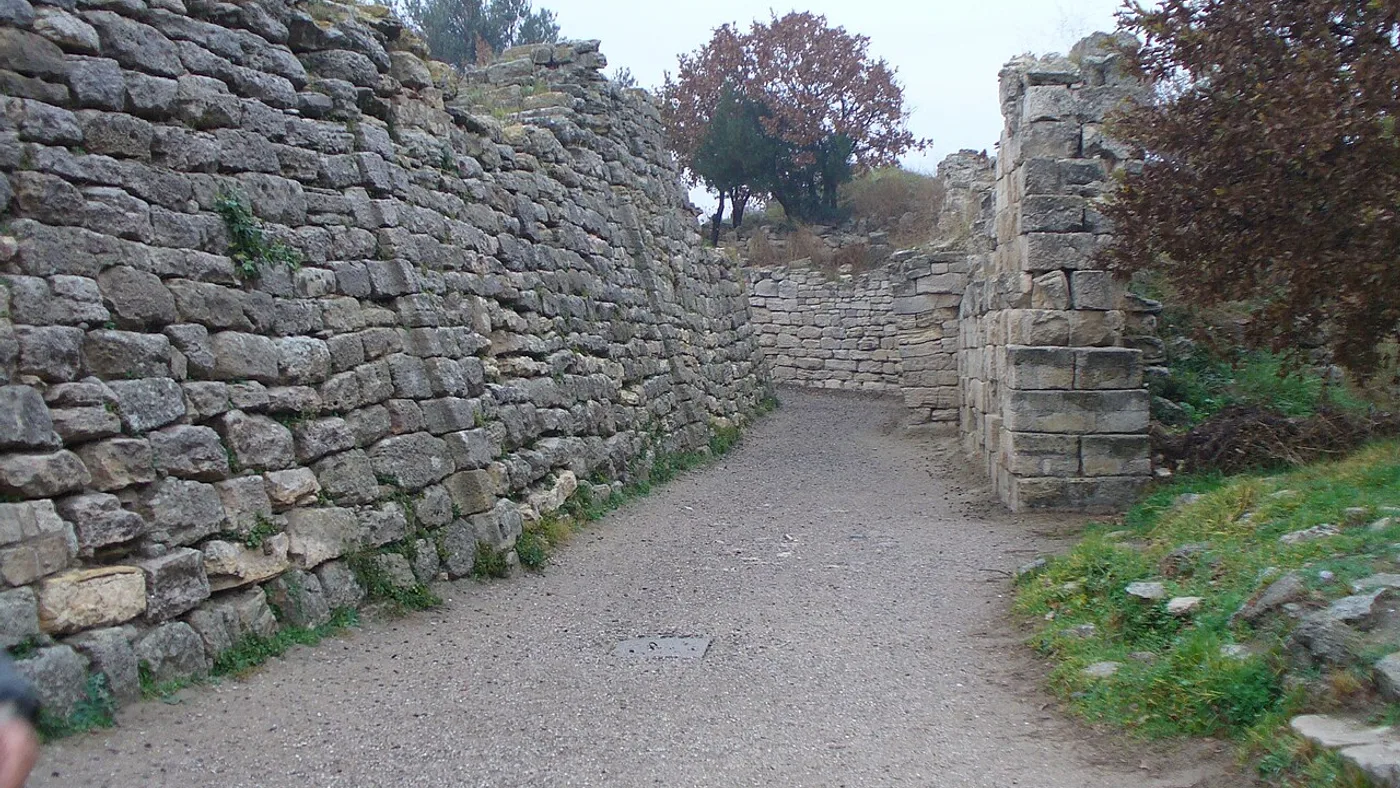
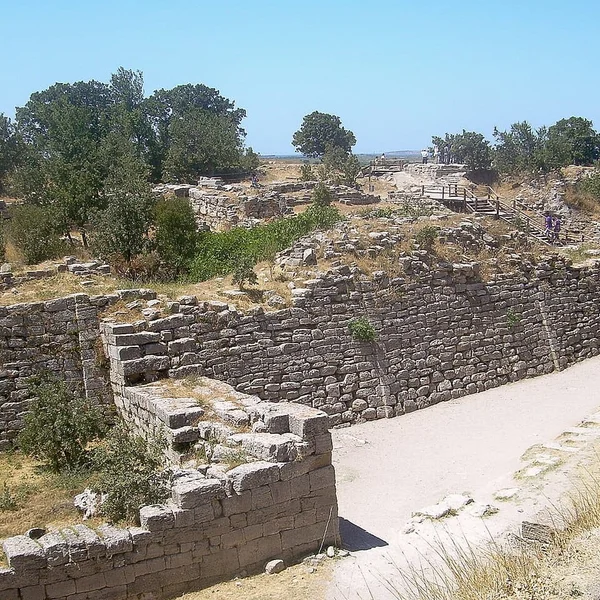
!Troy Citadel Walls and Archaic Stratigraphy
Figure 1: The monumental sloping fortification walls of Troy VI/VII at Hisarlık, upon which Archaic settlers of Troy VIII built their sanctuaries and civic agora. Photo: Wikimedia Commons / CC BY-SA 3.0.
Deconstructing the Headline: Epic Poetry vs Material Stratigraphy
Inevitably, popular news media greeted the October 2026 announcement with sensationalist headlines proclaiming the discovery of "Homer's flute" or "the first sound of the Trojan War." Such headlines reflect the enduring power of the Homeric mythos, yet responsible archaeological scholarship demands an immediate and uncompromising separation between poetic literature and stratigraphic reality.
As established by modern archaeological consensus, the Homeric Iliad is not a military field report; it is a complex oral epic crystallized in the late 8th or early 7th century BCE, drawing upon centuries of inherited poetic meter, Bronze Age memory, and contemporary Early Iron Age social realities. The stratigraphic candidates for the legendary conflict described in epic tradition belong to the Late Bronze Age:
- Troy VIh (c. 1300 BCE): A wealthy, monumental citadel characterized by majestic ashlar stone walls, destroyed not by siege warfare but by a catastrophic earthquake, as demonstrated by Carl Blegen and confirmed by Manfred Korfmann.
- Troy VIIa (c. 1190–1180 BCE): A crowded, defensively retrofitted citadel where storage jars were buried beneath house floors, bearing unambiguous evidence of violent destruction, fire, and unburied skeletal remains consistent with a brutal siege during the pan-Mediterranean Late Bronze Age collapse.
The newly discovered bone flute dates to roughly 750–700 BCE (Troy VIII). It post-dates the destruction of Troy VIIa by more than four centuries. The musician who played this instrument did not pipe warriors toward the ships of the Achaeans; rather, they stood upon the re-emerging acropolis of Archaic Ilion, performing in a living city that was actively reinterpreting its legendary ruins. The discovery is historically profound not because it proves the existence of Achilles or Hector, but because it recovers the authentic sonic environment of the very era in which the Homeric poems were being performed and committed to memory.
Dismantling the 'Dark Age' Hiatus Model
For decades following the pioneer excavations of Heinrich Schliemann and Wilhelm Dörpfeld, standard historical manuals asserted that the Bronze Age collapse plunged western Anatolia and the Aegean into a total civilizational void: the so-called "Greek Dark Ages." In this unilinear model, the great citadels were depicted as deserted stone ghosts, abandoned until fresh waves of Aeolian and Ionian Greek colonists supposedly recolonized empty landscapes around 700 BCE.
Modern geoarchaeological and ceramic research has systematically overturned this simplistic hiatus theory. Investigations directed by Manfred Korfmann and Ernst Pernicka of the University of Tübingen, and continued by Rüstem Aslan of Çanakkale Onsekiz Mart University (ÇOMÜ), have demonstrated undeniable settlement continuity through Troy VIIb1, VIIb2, and VIIb3:
- Material Continuities: The appearance of southeastern European "Knobbed Ware" (Buckelkeramik) in Troy VIIb2 (c. 1100 BCE) reflects regional population movements and cultural synthesis, not desolate abandonment.
- The 2026 Agora Discovery: Stratigraphic clearance immediately fronting the monumental southern gate of Troy VI revealed an 8th-century BCE paved marketplace and civic assembly area, proving that community administration was re-established within decades of the collapse.
- Re-use of Prehistoric Megaliths: Archaic builders did not level the citadel; they deliberately integrated Bronze Age ashlar bastions into their new civic spaces, treating the prehistoric stone as sacred ancestral topography.
The 2,800-year-old bone flute belongs directly to this vibrant recovery phase. It indicates that 8th-century BCE Troy was not a desolate military outpost, but a ceremonial center equipped with skilled artisans, ritual specialists, and musical performance traditions.
Organology: The Mechanics of the Archaic Bone Aulos
In the discipline of ancient organology (the study of musical instruments), wind instruments made of hollow animal bone hold a distinguished place. The Hisarlık specimen was fashioned from the dense, tubular long bone of an ungulate: most likely the sheep or goat metatarsal or metacarpal, favored across the Aegean and Anatolia for their uniform wall thickness and acoustic resonance.
The Double-Pipe Tradition
Contrary to modern colloquial translations that refer to the find as a "flute," the instrument is typologically an aulos (plural auloi). While a true flute produces sound via an open-hole embouchure (like a modern orchestral flute or panpipe), the ancient Greek and Anatolian aulos was a reed instrument:
- Reed Mechanism: The player blew through a vibrating double-reed cane mouthpiece (glotta), functioning mechanically closer to a modern oboe or shawm.
- Pitched Pipes: Auloi were almost universally played in pairs. The performer inserted both pipes into their mouth, secured around the cheeks by a leather strap known as a phorbeia to maintain consistent buccal air pressure.
- Finger-Holes (Bytes): Carefully spaced drilled holes allowed the piper to modulate pitch. One pipe frequently maintained a continuous modal drone while the other played the melodic variation.
```
[Mouthpiece / Glotta]
------------------------------ (Bone Pipe 1: Melody) o o o o
------------------------------ (Bone Pipe 2: Drone) o o o
[Flaring Bone Bell]
```
The resulting acoustic timbre was described by ancient writers not as soft or soothing, but as piercing, passionate, and stirring. An aulos was capable of cutting through the roar of strong sea winds, chanting crowds, and the crackle of open-air sacrificial pyres.
Polycentric Soundscapes: Anatolia, Mesopotamia, and the Levant
Music in the ancient Mediterranean was never an isolated or strictly Hellenic development. Long before the bone flute of Troy VIII was carved, western Asia was crisscrossed by sophisticated musical technologies and theoretical systems:
1. Phrygia and the Cult of Cybele (Gordion)
Just east of the Troad, in central Anatolia, the Phrygians were universally recognized by the Greeks as the masters of woodwind music. Phrygian myth celebrated Marsyas, the silen who picked up the discarded aulos of Athena and challenged Apollo's lyre. At the Phrygian capital of Gordion, excavations have yielded exceptionally preserved bone and boxwood musical components dating to the 8th and 7th centuries BCE, closely contemporary with the Trojan pipe. The ecstatic, percussion-driven rites of the Mother Goddess Cybele relied entirely on the double aulos to induce ceremonial trance.
2. The Ugarit Diatonic Hymn (Late Bronze Age Syria)
Over six centuries before the Troy flute, the royal archive of Ugarit produced the famous Hurrian Hymn no. 6 (c. 1400 BCE). Inscribed in cuneiform on clay tablets, these texts contain the world's oldest surviving written musical score, detailing a nine-stringed diatonic tuning system and harmonic intervals played on the Levantine lyre (sammû).
3. The Royal Cemetery of Ur (Mesopotamian Sumer)
Dating back to the mid-third millennium BCE (c. 2500 BCE), the sensational silver and lapis lazuli bull-headed lyres discovered by Sir Leonard Woolley at Ur demonstrate that stringed and wind acoustics were already central to royal funerary liturgy eight hundred years before the construction of Troy VI.
The Trojan bone flute stands at the geographic and cultural crossroads of these worlds. Situated at the maritime mouth of the Hellespont, Archaic Ilion was uniquely positioned to absorb both Aeolian lyric bards and Anatolian sacred woodwind traditions.
The 4,500-Year-Old Gate Idol: Bronze Age Ancestors
The dramatic resonance of the October 2026 campaign was doubled by the concurrent discovery of an Early Bronze Age anthropomorphic stone idol head near an ancient citadel gateway. Dated to c. 2500 BCE (Troy II or III), this small sculpted head was shaped during the era when Troy was first fortified with massive stone towers and monumental mudbrick megaron halls.
In third-millennium BCE Anatolia, schematic stone idols with disk-shaped faces, incised brows, and stylized noses served apotropaic functions. Positioned at gateway thresholds or sealed within foundation deposits, they served as ritual guardians meant to repel malignant forces and protect municipal borders.
That this 4,500-year-old guardian stone lay buried only meters away from an 8th-century BCE bone flute epitomizes the miraculous multi-layered stratigraphy of Hisarlık. In a single excavation trench, visitors and archaeologists confront the physical tangible artifacts of two vastly different worlds: the silent, enigmatic stone gaze of third-millennium bronze smiths, and the lyrical, resonant bone instrument of the Archaic polis.
Conclusion: Listening to the Citadel
As laboratory conservators and archaeo-musicologists begin CT-scanning the bone pipe fragment, analyzing micro-wear striations around its finger-holes, and reconstructing its exact acoustic tuning pitches, the discovery offers modern archaeology a profound emotional shift.
Archaeological sites are too often visualized as silent, monochrome ruins: stone foundations bleached by the sun, pottery sherds cataloged in drawers, and fortification diagrams drawn on paper. Yet ancient cities were cacophonous sensory environments. At Troy, above the ceaseless gusting of the northern winds that Homer called "windy Ilios" (Ilion ēnemoeis), there was music. The newly discovered bone pipe restores that missing frequency, allowing us to listen, across twenty-eight centuries, to the living citadel.