
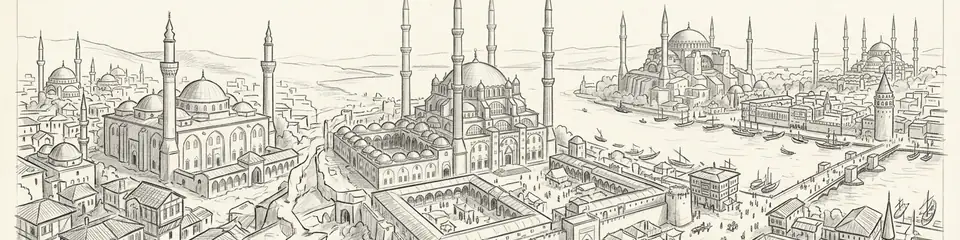
The Ottoman Empire lasted six centuries and stretched across three continents. It had, in the course of its history, four capitals — but three of them are still here, and the journey between them traces not just a political history but an architectural one, from the intimate wooden city of the early sultans to the great imperial mosques that remain among the most audacious buildings ever constructed.
Bursa: Where It Began
"I have built this mosque to rival the great Hagia Sophia."
— Attributed to Mimar Sinan on the Selimiye Mosque (1575)
!The Green Mosque and Green Tomb complex in Bursa with Uludağ in the background
Bursa was the first Ottoman capital, captured from Byzantium in 1326 and the center of Ottoman power for roughly a century before the capital moved to Edirne. It sits at the foot of Mount Uludağ, in a green valley above the Marmara plain, and it preserves the tombs of the first sultans in a garden of plane trees that has the feeling of something carefully tended for a very long time.
The Green Mosque (Yeşil Cami) and its associated Green Tomb, built in the early fifteenth century under Mehmed I, are considered the finest examples of early Ottoman architecture. The mosque's interior tiles, in a jade and turquoise palette that gives the buildings their name, were made by craftsmen from Tabriz and represent a meeting of Persian, Seljuk, and emerging Ottoman sensibilities. The nearby Grand Bazaar is one of the oldest covered markets in the world, continuously in operation since the fourteenth century.
Bursa is also the birthplace of Karagöz, the shadow puppet tradition that became one of the emblematic arts of Ottoman popular culture. The tradition is said to have been inspired by two workers — Karagöz and Hacivat — who worked on the construction of the Bursa mosque and whose comic arguments entertained the other laborers. Whether the story is true, it captures something real about Bursa: a city comfortable with its own mythology.
Edirne: The Gateway to Europe
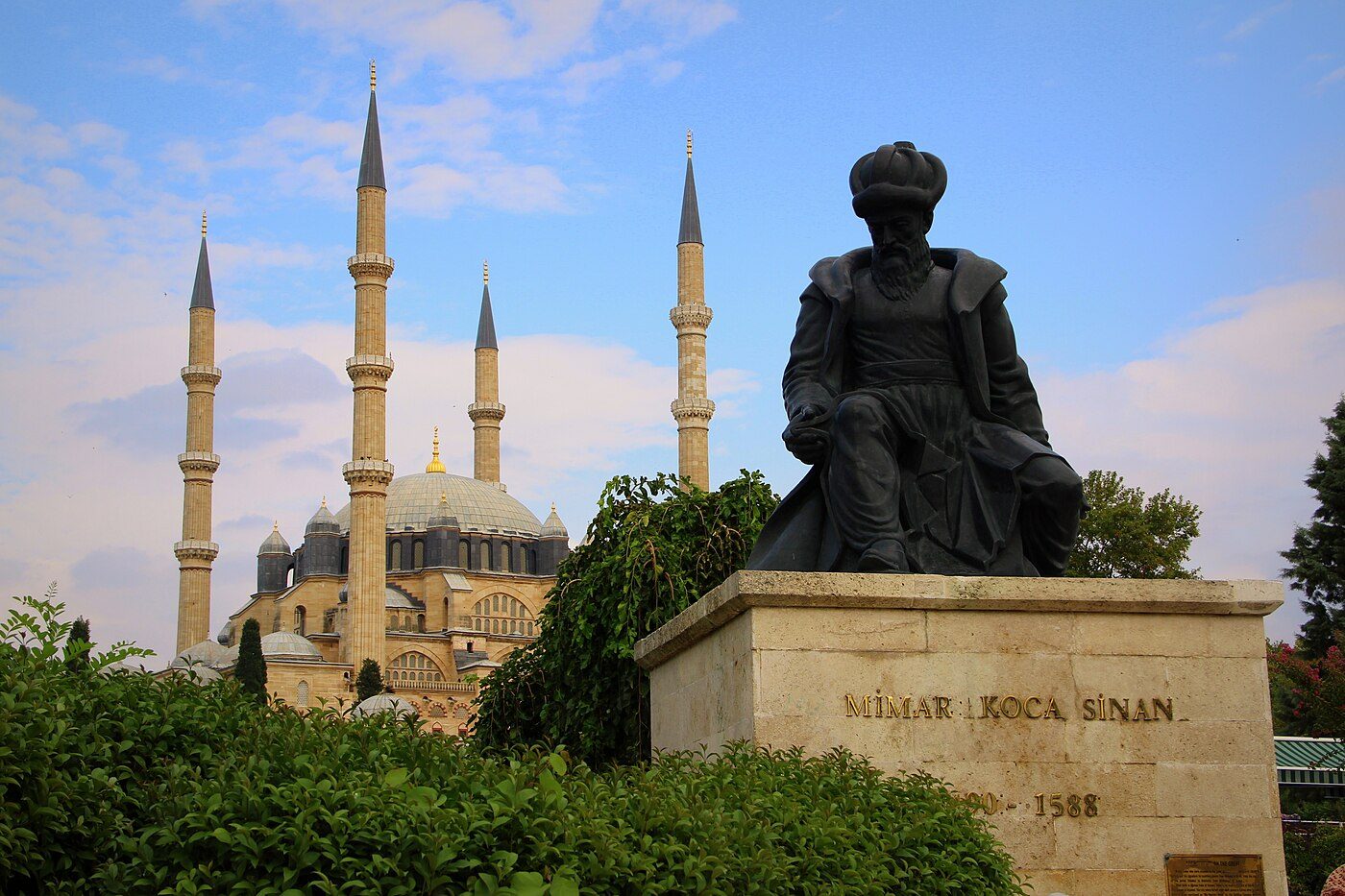
!The Selimiye Mosque by Mimar Sinan rising above the city of Edirne · Wikimedia Commons")
에디르네(고대명 아드리아노폴리스)는 유럽 대륙의 가장자리, 두 강이 합류하는 지점 부근에 자리 잡고 있다. 1369년부터 1453년까지 오스만 제국의 수도였으며, 훗날 콘스탄티노플을 함락하게 될 원정들의 출발 기지였다. 수도를 옮긴 뒤에도 에디르네는 제국의 제2도시이자 오스만 건축의 최고 걸작이 세워진 곳으로 남았다.
1575년 셀림 2세의 명으로 제국 수석 건축가 미마르 시난이 설계하여 완공한 셀리미예 모스크는 이슬람 건축사 연구자들 다수가 오스만 전통에서 가장 위대한 건축물로 평가한다. 완공 당시 이미 여든이 넘었던 시난 자신도 이 건물을 자신의 대표작이라 칭했으며, 하기아 소피아에서 이룩된 비잔티움의 성취를 능가했음을 입증하는 건축물이라고 말했다. 셀리미예의 돔은 하기아 소피아의 돔보다 약간 더 크다. 네 개의 미나레트는 고전 오스만 양식으로 세워진 것 중 가장 높다. 999개의 창을 통해 빛이 쏟아져 들어오는 내부는 절제된 초월성을 구현한 공간이다.
시난 자신도 주목할 만한 인물이었다. 16세기 초에 태어나 예니체리 군단에 입대하여 여러 군사 원정에 참전했고, 자신의 조직적·수학적 재능을 건축으로 전환했다. 1588년 약 아흔 살의 나이로 사망할 때까지 그는 제국 전역에서 370개가 넘는 구조물을 설계하거나 건축을 감독했다.
사프란볼루: 목조 도시
!사프란볼루의 계곡을 따라 늘어선 전통 오스만 목조 가옥들
1994년 유네스코 세계유산으로 지정된 사프란볼루는 전통 오스만 주거 건축의 가장 잘 보존된 사례를 간직하고 있다. 가파른 계곡에는 17세기에서 19세기 사이에 지어진 약 2천 채의 목조 골조 가옥이 들어서 있다. 각 가옥은 위층이 돌출되어 있고, 내부에는 화려한 조각이 장식되어 있으며, 공적인 접견 공간과 사적인 가족 공간을 분리하는 공간 구성을 갖추고 있다.
사프란볼루의 가옥들은 이 도시가 이스탄불과 흑해를 잇는 대상로의 주요 거점이던 시기에 지어졌다. 사프란(safran)은 튀르키예어로 샤프란을 뜻하며 도시의 이름도 여기서 비롯되었는데, 샤프란 무역이 부를 가져왔고, 그 부로 가옥을 지었으며, 이후 수 세기 동안의 상대적 고립이 그 가옥들을 보존했다. 사프란볼루의 뒷골목을 걷는 것은 근대화 이전의 평범한 오스만 도시가 어떤 모습이었는지 이해하는 데 가장 가까이 다가가는 일이다.
코니아: 정신적 수도
!코니아 메블라나 박물관의 상징적인 청록색 돔 · Wikimedia Commons")
콘야는 12세기와 13세기에 룸 셀주크 술탄국의 수도였으며, 수피 시인 잘랄 앗딘 무함마드 루미가 생애에서 가장 생산적인 시기를 보내고 1273년에 묻힌 곳이 바로 이곳이다. 그의 묘와 그가 창시한 메블레비 데르비시 수도회의 수도원을 포함하는 메블라나 박물관은 튀르키예에서 가장 많은 방문객이 찾는 장소 중 하나이자 이슬람 신비주의 역사에서 가장 중요한 유적 중 하나이다.
권력과 신앙의 건축
이 도시들을 연결하는 것은 일관된 건축 논리이다. 즉, 예배 공간, 교육 시설, 무료 급식소, 시장을 하나의 와크프(종교 재단)로 결합하여 도시의 구조를 형성한 모스크 복합단지가 도시 발전의 원동력이었다는 점이다. 건축적으로 접근하든, 역사적으로 접근하든, 혹은 단순히 놀라운 장소들 사이를 이동하는 여행자로서 접근하든, 부르사에서 에디르네를 거쳐 사프란볼루로 이어지는 여정은 역사상 위대한 건축 전통 중 하나와 일관된 조우를 제공한다. 이 전통은 단지 기념비적인 건축물만이 아니라 도시 자체를 건설한 전통이었다.


