
Two papers published in Nature on September 9 report findings from Bianfu Cave in Yunnan, China, including Denisovan skull fragments, teeth, and part of an arm identified through ancient protein analysis. The remains date to roughly 167,000–134,000 years ago, within a cave sequence extending from about 190,000 to 70,000 years ago.
The chronology makes Bianfu Cave far more than the source of another fragmentary fossil. Its long sequence of stone tools, animal remains, and other deposits provides a setting for asking how people used the cave and its surrounding landscape over time. It does not show that Denisovans made every tool or occupied every layer, but it offers far more context than an isolated bone.
For years, Denisovans were known chiefly through DNA. Bianfu Cave gives that genetic population a physical and archaeological setting: fragmentary anatomy, a place, associated materials, and a record of repeated human activity.
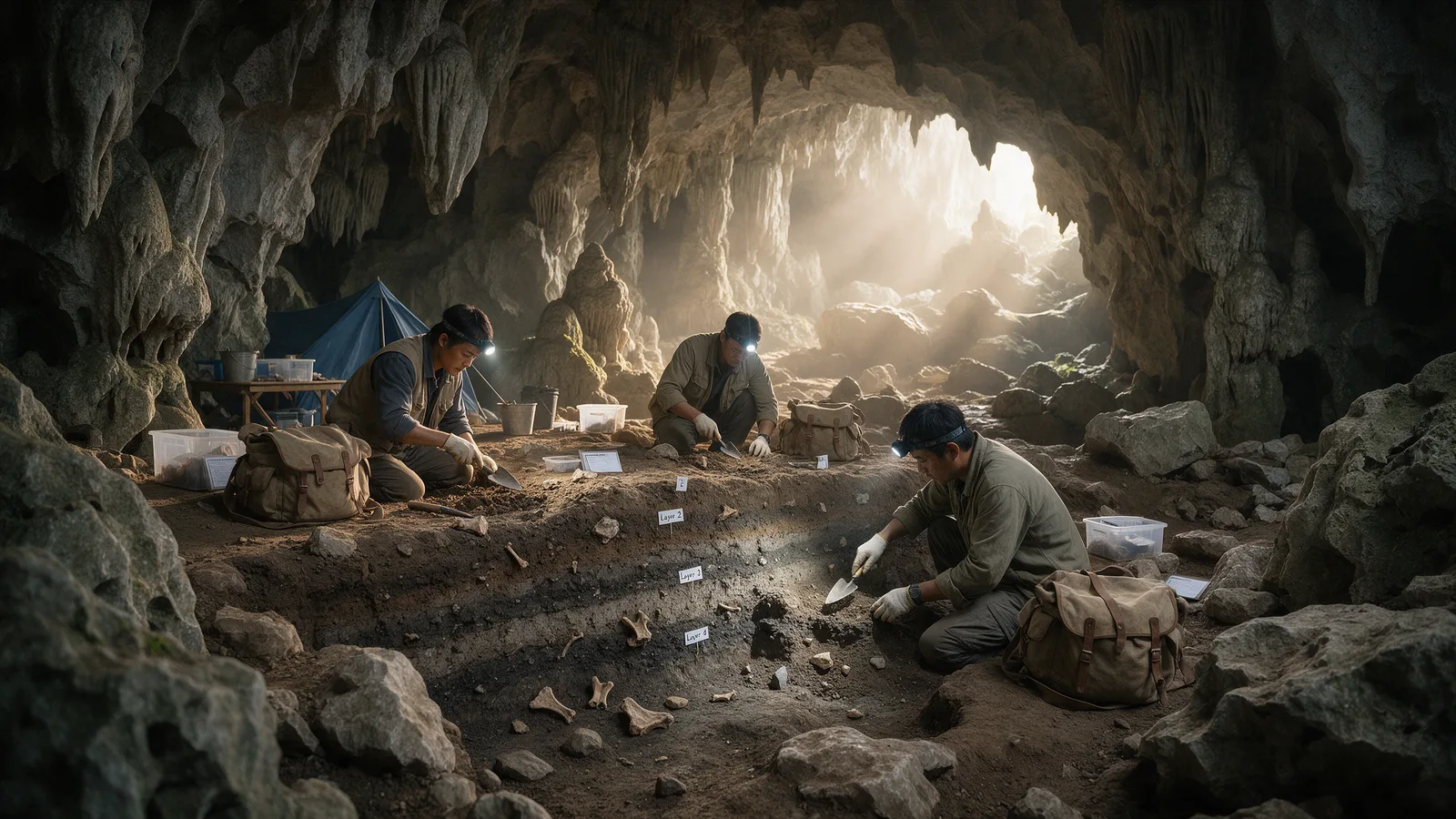
!Archaeological excavation of Middle Paleolithic sediment layers in a deep karst cave
Stratigraphic excavation of Pleistocene cave sediments in Southwest China, where ancient hominin remains and lithic artifacts were unearthed. Reconstruction rendered via Magnific AI.
From genetic discovery to archaeological population
Denisovans were an ancient human population related to both Neanderthals and modern humans. Scientists first recognized them from genetic material recovered at Denisova Cave in Siberia, before they had a substantial collection of distinctive Denisovan bones. The population was therefore identified before researchers knew much about its anatomy or daily life.
Later genetic studies showed that Denisovan ancestry survives in some living populations, particularly in parts of Asia and Oceania. They also revealed a complicated population history, including genetic diversity within Denisovans and encounters with other human groups, including Neanderthals and the ancestors of modern humans.
!Denisova Cave entrance in the Altai Mountains of Siberia
Denisova Cave in the Altai Mountains of southern Siberia, Russia, where Denisovan DNA was first isolated in 2010. Photo: Wikimedia Commons / CC BY-SA 4.0.
Genetic evidence can show relationships, movement, and mixture, but it cannot by itself explain how Denisovans lived. It does not identify the tools they used, the animals they processed, or the environments in which they spent their time. Those questions depend on archaeological evidence.
Bianfu Cave brings that evidence into the same investigation.
!The Xiahe mandible discovered in Baishiya Karst Cave on the Tibetan Plateau
The Xiahe mandible from Baishiya Karst Cave, Xiahe, Gansu Province, China—previously the primary fossil evidence of Denisovans outside Siberia, identified through ancient collagen proteome analysis. Photo: Dongju Zhang / Wikimedia Commons / CC BY-SA 4.0.
What protein analysis adds
Ancient DNA is powerful but fragile. It breaks down over time, and warm environments can make preservation especially difficult. Proteins can survive in some fossils after usable DNA has disappeared.
Researchers can compare preserved protein sequences from teeth and bones with reference data from modern humans, Neanderthals, Denisovans, and other relatives. The method does not provide the information contained in a complete genome, but it can help identify fossils that are too incomplete for conventional anatomical classification.
!Bioarchaeology laboratory inspecting ancient bone fragments and protein mass spectrometry
Palaeoproteomic peptide mass fingerprinting enables researchers to sequence ancient collagen proteins from highly fragmented fossils when ancient DNA has degraded in warm subtropical climates. Visualization rendered via Magnific AI.
That matters because many human fossils are damaged or naturally fragmentary. A complete skull may preserve features useful for comparison; a small bone fragment or worn tooth usually does not. Protein evidence can give such remains a biological identity and make them relevant to a broader archaeological record.
At Bianfu Cave, protein analysis identified Denisovan skull fragments, teeth, and part of an arm. The finding expands the search for Denisovans beyond sites where ancient DNA has survived and gives researchers a reason to revisit fragmentary fossils that once seemed impossible to classify.
!Denisova 4 fossil molar tooth replica showing robust archaic morphology
Replica of the Denisova 4 molar tooth discovered in Siberia, displaying the exceptionally large crown and flared roots characteristic of Denisovan dental anatomy. Photo: Wikimedia Commons / CC BY-SA 4.0.
Why the cave sequence matters
An isolated fossil establishes that an individual existed. A long archaeological sequence can show whether people returned to a place, how conditions changed, and what kinds of activity accumulated there.
The Bianfu sequence covers approximately 120,000 years, from about 190,000 to 70,000 years ago. The Denisovan remains date to roughly 167,000–134,000 years ago, within the earlier part of that sequence. Those dates create a framework for investigating human activity through time, but they do not automatically assign every layer or artifact to Denisovans.
!Middle and Upper Paleolithic stone tools and bone points
Pleistocene stone flakes, blade cores, and worked bone artifacts, similar to the lithic assemblages recovered across the 120,000-year cave sequence. Photo: Wikimedia Commons / CC BY-SA 4.0.
Stone tools and animal remains give researchers material with which to investigate activity at the site. The tools may help reconstruct how people worked stone and other materials; the animal remains may provide evidence about food acquisition, carcass processing, and local environmental conditions. Their value lies partly in context: the fossils can be studied as remains found within a human landscape, not merely as biological specimens.
Genetics cannot provide that kind of record. DNA can reveal population relationships and admixture, but rarely shows how a stone was made into a tool, how an animal carcass was treated, or how a cave was used. Those patterns have to be reconstructed from physical remains.
The cave also creates opportunities to compare Denisovans with other human populations that occupied Asia during the same broad period. They can now be investigated not only as ancestors or genetic contributors, but as members of past communities whose activities may be recoverable in particular places and layers.
!Baishiya Karst Cave entrance high on the Tibetan Plateau
Baishiya Karst Cave at 3,280 meters above sea level on the Tibetan Plateau in Xiahe, Gansu Province, highlighting Denisovan adaptations to extreme high-altitude alpine zones. Photo: Wikimedia Commons / CC BY-SA 4.0.
Asia’s missing human populations
Asia was home to multiple human populations over hundreds of thousands of years, but its fossil record is uneven. The region is vast, excavation histories vary, and many sites have been damaged, poorly preserved, or only partially investigated.
Climate compounds the problem. In warm conditions, DNA often degrades rapidly. Bone may fragment or disappear, leaving researchers with teeth, tiny pieces of bone, or sediments instead of recognizable skeletons. A population can therefore survive in the genetic history of later humans while remaining difficult to see in the conventional fossil record.
!Subterranean karst limestone cave chamber in Yunnan Province
Subterranean karst limestone cave formations in Yunnan Province, southwestern China, where sheltered karst chambers provide rare microclimates capable of preserving ancient Pleistocene fossils and stratified cultural deposits. Photo: Wikimedia Commons / CC BY-SA 4.0.
The Denisovan story shows how long that invisibility can last. Before genetic analysis revealed them, Denisovans were not represented by the familiar fossil collection associated with Neanderthals. Biomolecular methods changed the task: researchers could look beyond a fragment’s visible anatomy and ask what biological information it still preserved.
That approach may reveal more than Denisovans. Some lost populations in Asia may survive only as genetic traces in living people. Others may be represented by fragmentary fossils that have not yet been tested with proteins or examined in a secure archaeological context.
A missing fossil record is therefore not proof that a population was absent. It may reflect preservation, sampling, or the limits of the methods available when older collections were first studied.
What remains unresolved
Bianfu Cave strengthens the geographic and archaeological case for studying Denisovans, but it does not provide a complete picture of the population.
The fossils are fragmentary. They cannot establish the full range of Denisovan anatomy or show how Denisovans differed from Neanderthals and modern humans across their entire geographic range.
Nor can the cave provide direct evidence of language, beliefs, or social organization. Tools and animal remains reveal patterns of activity, but not necessarily the rules or meanings behind them.
Attribution remains a central problem. Different human populations may have used the same cave at different times, and objects in a long sequence cannot automatically be assigned to Denisovans. Secure dates and supporting fossil, protein, or genetic evidence are needed to connect particular activities with particular populations.
Future discoveries will help test how widely Denisovans ranged, whether distinct Denisovan populations occupied different parts of Asia, and how their technologies changed across environments. More fossils, better dates, and biomolecular evidence from other sites will be essential.
Denisovan biological identification confirmed via palaeoproteomics
Stratified cave sequence spanning 190,000 to 70,000 years ago
Denisovans inhabited subtropical lowlands of southern China (167,000–134,000 BP)
Every stone tool and cultural layer in Bianfu Cave made exclusively by Denisovans
Full anatomical morphology of Denisovans established from Bianfu fragments
A fuller human history
Bianfu Cave supports a view of human evolution in Asia as a history of overlapping populations, movement, mixture, and disappearance—not a simple sequence in which one group replaced another across the continent.
Its importance lies in bringing different kinds of evidence together. Denisovan genetics can now be considered alongside human remains, cave sediments, stone tools, animal resources, and repeated occupation. The result is a shift in emphasis: from asking only who Denisovans were related to toward asking how they used particular places.
A damaged tooth, an unassignable bone, or a trace of inherited DNA may preserve evidence of a population that conventional archaeology has missed. But fragments become meaningful only when researchers can place them in time, identify them reliably, and connect them to a wider archaeological context. Bianfu Cave is important because it brings those pieces closer together.


